Category Archives: Esoterics

ABRACADABRA

When an old-school magician is about to reveal the seemingly impossible, he will often invite his audience to participate in the revelation by reciting the well-known “magic word” that has long been associated with transformation.

“Now,” says the man in the tuxedo with tails, “we must say the magic word.”

And that word is already on the lips of nearly every member of the crowd.

“Abracadabra,” they intone.

But what does that mean, exactly? It certainly sounds mysterious and rhythmic enough to be a magic word. Strange, how easily it rolls off the tongue despite its foreign feel…

I suspect that I’ll get some hate mail from a few illusionists for sharing what I’m about to disclose, but no matter. (Your enlightenment means so much more to me than their rants of condemnation!)

The earliest, documented use of the word “abracadabra” comes from the Roman imperial advisor Quintus Sammonicus Serenus in the late second century CE. In his only fully surviving work, De Medicina Praecepta, Serenus gives a treatment for ague (acute fever) that features the word etched into an inverted triangular amulet, thus:

A – B – R – A – C – A – D – A – B – R – A
A – B – R – A – C – A – D – A – B – R
A – B – R – A – C – A – D – A – B
A – B – R – A – C – A – D – A
A – B – R – A – C – A – D
A – B – R – A – C – A
A – B – R – A – C
A – B – R – A
A – B – R
A – B
A

The late Amram Kehati (PDF) argued that the origin was Hebrew and that it was comprised of three words: ARBA – ACHAD – ARBA, meaning FOUR – ONE – FOUR; which seems to correspond to the prescription by Serenus that the amulet be worn for nine days.

The explanation sounds logical, especially when the word is viewed from right-to-left, in the manner that the Hebrew language is read. However, there remains a troublesome transposition of the C and D. This would have the second of the three conjoined words reading ADACH (or DACHA) rather than ACHAD.

While it’s true that “the magic word” comes from Hebrew, the derivation emerges from a spoken (rather than written) emulation of the original phrasing.

Rabbi Jeffrey Summit relates that the word stems from the Hebrew phrase “abra k’davrah”, meaning, “it came to pass as it was spoken”. This interpretation can also be logically (and historically) connected to the reason why the amulet was prescribed to be worn for nine days.

After the destruction of Jerusalem and the complete desolation of the second Jewish Temple by Roman forces in 70 CE, some prophets of the day turned a scornful eye upon Rome and prophesied against it. Nine years (plus one month and one day) later, the world’s then-greatest empire was rocked by a calamity of biblical proportions: the eruption of Vesuvius, which brought with it the fiery obliteration of the cities of Pompeii, Herculaneum, Oplontis and Stabiae.

That tumultuous event deeply affected Serenus (though born about a century after the fact) because he was a passionate devotee of the work of Pliny the Elder. Pliny, the great Roman scholar and physician, perished while attempting a sea rescue of family and friends from Stabiae. This would then also seem to lend significance to the fact that the amulet designed by Serenus is shaped like an inverted volcano — as if to counter the earth’s paroxysmal fever.

In the world of performance magic, however, there’s another translation that might be well-suited, if ironic.

ABRACADABRA can also be broken out as follows:

HA’BRACHA’DAVRAH, meaning, The Blessing Word; or simply,

“The Magic Word”

Leave a comment

Filed under Esoterics, Reason

Ronnie Said So

reagan

© 2002, José V. Chung & Graphic Exchange (image adapted slightly)


Read the original October, 2002, article as published in Graphic Exchange magazine. It’s a strange but workable combination of astronomy, Deep Impact and the X-Files: colorspace.pdf (1 MB)


Leave a comment

Filed under Conflict, Esoterics, Life

Daniel 7:5

bear

Daniel 7:5 — And behold another beast, a second, like to a bear, and it raised up itself on one side, and it had three ribs in the mouth of it between the teeth of it: and they said thus unto it, Arise, devour much flesh.

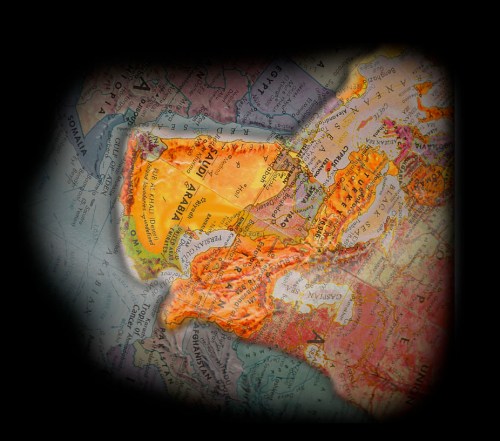
Map rotated ~120° clockwise (raised up on one side).
The mouth of Daniel’s bear could be the Persian Gulf.
The teeth are Hormuz (Musandam), Qatar and Bahrain.
Three ribs (long, flat shapes) are caught/consumed between.

1 Comment

Filed under Conflict, Esoterics, Images

Origin of the Rigveda

(Note: Yes, the image below is not from the Rigveda, but from a Nepalese Devimahatmya palm leaf scroll. Just intended to demo a little Sanskrit.)

sanskritThe Rigveda is the oldest extant collection of Vedic Sanskrit hymns and was composed during the early Vedic period (1700 – 1100 BCE) by the Rishis (sages). It was during the earliest portion of this era that Abraham/Ibrahim was traveling through the Indus Valley region.

Accordingly, both the words, Rigveda and Rishi, have related Sanskrit/Hebrew roots. In Sanskrit, Rigveda is a compound of the roots “rc” (“praise”) and “veda” (“knowledge”). In a Semitic twist, we also see that the Hebrew root compound means very much the same thing.

The Hebrew root “reg-” means “festival”, as in the word “regalim” (“times” or “festivals” [of praise]). As a rule, a festival is always held at a specific point in the yearly calendar, hence the use of the root “reg” to also imply “time”, “measure”, “standard” or “rule”; this later carried over into both Greek and Latin. The meaning of “veda” in Sanskrit is precisely the same as for the Hebrew word “yedda” (knowledge).

The Sanskrit word “Rishi” (sage[s]/seer[s]) is equivalent to the Hebrew word “arshim” (sages). In fact, there are a number of examples of words with the Sanskrit root “rish” that translate directly with Semitic words with the root “arsh”.

The Rigveda begins with the Hymn of Creation. Below, you can see how similar it is in its ex nihilo premise to Genesis 1 (b’reshith aleph) of the Hebrew Bible.

The Creation Hymn

A time is envisioned when the world was not, only a watery chaos (the dark, “indistinguishable sea”) and a warm cosmic breath, which could give an impetus of life. Notice how thought gives rise to desire (when something is thought of it can then be desired) and desire links non-being to being (we desire what is not but then try to bring it about that it is). Yet the whole process is shrouded in mystery.

Where do the gods fit in this creation scheme?

The non-existent was not; the existent was not at that time. The atmosphere was not nor the heavens which are beyond. What was concealed? Where? In whose protection? Was it water? An unfathomable abyss?

There was neither death nor immortality then. There was not distinction of day or night. That alone breathed windless by its own power. Other than that there was not anything else.

Darkness was hidden by darkness in the beginning. All this was an indistinguishable sea. That which becomes, that which was enveloped by the void, that alone was born through the power of heat.

Upon that desire arose in the beginning. This was the first discharge of thought. Sages discovered this link of the existent to the nonexistent, having searched in the heart with wisdom.

Their line [of vision] was extended across; what was below, what was above? There were impregnators, there were powers: inherent power below, impulses above.

Who knows truly? Who here will declare whence it arose, whence this creation? The gods are subsequent to the creation of this. Who, then, knows whence it has come into being?

Whence this creation has come into being; whether it was made or not; he in the highest heaven is its surveyor. Surely he knows, or perhaps he knows not.

wsu.edu

The tone and approach are different from Genesis, but a good part of the story is the same. The original story of the creation was passed down orally from Adam and later recorded by Abraham as part of the Book of Formation (Sefer Yetzirah — which answers many of the questions posed in the vedic hymn). Many years later, it was reconstituted by Moses at Sinai in both an Oral and Written form.

It’s now likely that you will think of Abraham/Ibrahim the next time you hear the words “brahma”, “brahmana” or “brahmin”.

If you are Hindu or Buddhist, please take no offense. It only means that we are all indeed brothers. And, if you are Daoist, you’re not getting off scott-free; turns out Lao-tse may also have been a Jew who traveled to southwestern China from the expanding Medo-Persian empire.

For further reading on this slant, you might want to check out this cached link, “Indian Abraham” (the original seems to have gone missing). Some erudite work done there. I can’t subscribe to all of it, but it is, nonetheless, an excellent read. And maybe an eye-opener for some.

And then there’s Dr. Ken Biegeleisen’s 1994 book, “Whoever You Thought You Were… You’re a Jew!” But, Dr. Ken is not just a theo-social commentator; his paper on Circular DNA is most definitely worth checking out.

2 Comments

Filed under Esoterics, Words

From Baikonur to Samarobryn

351712main_exp20crew_launch(NASA) Flight Engineers Roman Romanenko, Frank De Winne and Robert Thirsk of the 20th International Space Station crew launched in their Soyuz TMA-15 from the Baikonur Cosmodrome in Kazakhstan at 6:34 a.m. EDT Wednesday to begin a six-month stay in space. 

Expedition 20 will mark the start of six-person crew operations aboard the International Space Station. All five of the international partner agencies – NASA, the Russian Federal Space Agency (Roscosmos), the Japan Aerospace Exploration Agency (JAXA), the European Space Agency (ESA) and the Canadian Space Agency (CSA) – will be represented on orbit for the first time…. (Read more here)
 

240px-ISS_March_2009Nostradamus, Century VI, Quatrain 5

Si grand famine par onde pestifère, 
Par pluie longue le long du pôle arctique:
Samarobryn cent lieues de l’hémisphère,
Vivront sans loi exempt de politique

A very great famine caused by a pestilent wave
through long rain the length of the Arctic pole.
In Samarobryn, one hundred leagues from the hemisphere;
they will live without law, exempt from politics.

1 Comment

Filed under Esoterics