
The UN Security Council has unanimously condemned North Korea’s latest nuclear firing test, which everyone seems to be assuming is their second such detonation, though that might not be the case.
The precise yield of the explosion is difficult to gauge for the following reasons:
- Given the DPRK’s proficiency at digging shafts, tunnels and underground facilities, they may be successfully shielding and shaping their blasts in order to minimise their seismic signatures. If different device placement configurations are used for each test, this will help to confound those attempting to ‘profile’ the device in question — and, over a series, it will tell the North Koreans which configurations work best.
- The seismic waves generated by the most recent test are distinctly different from their first known test on October 9, 2006, which could mean that a different device type may have been employed this time, in which case, the previous data will be somewhat less useful in determining the energy output of the test at hand.
- Russian seismographs have been off-line for quite some time, limiting the number of high quality data points when interpreting the test’s meaning and ultimate implications. The Chinese ones have been running off-and-on for a good part of the past few months, which has proved less than helpful to seismic monitoring efforts focused on that part of the world.

As compared to the first test, the blast barely registered a blip at China’s QIZ seismograph located at Guangzhou, Guangdong Province, which responded quite emphatically to the October 9th test. (See last story this topic.)

Russian sources estimate the test’s yield to be in the range of 10 to 20 kilotons — which are the same figures they proposed for the first test, which turned out only to have generated a blast force of less than one kiloton. It makes you wonder about the value of Russian contributions on these matters.
I’m still digesting the news (and the data), but I’ll take a stab at guessing the yield on this newest test — which could be anything from the country’s second to tenth nuclear test.
Best guesstimate at this time: 5 – 10 kT.
Note: There is also a possibility that two tests could have been conducted in almost immediate sequence (about 15 minutes apart) — with the second test of the day yielding roughly double the energy of the first. In other words: two tests registering 5 kT and 10 kT, respectively. (I can’t find a quake to match up with that second, slightly larger, blip. Maybe you can.)
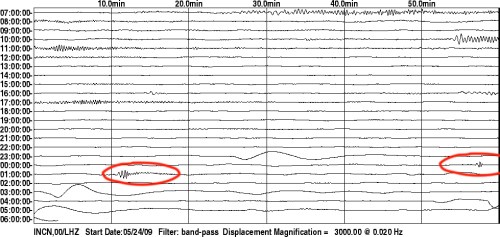
Did North Korea score a 2-for-1 deal once again?
Now, I guess we just wait to see what happens next.
 Most people have no idea that Albert Einstein and Leo Szilárd invented a

 imahd.ca