
Newton taught us that for every action there is an equal and opposite reaction. This “third law” of the universe was obviously intended to be applied in the physical sciences. Newton had no idea that the concept would attain such prominence in the informal (pop) social sciences hundreds of years later, nor that it might even be cited as pseudo-scientific justification for blind moral relativism that prejudicially confers equality upon competing narratives while disregarding obvious disparities in their provenance.
Category Archives: Science
Mex-US-Can Initiative to Convert Mexican Reactor to LEU
The White House
Office of the Press Secretary
.
For Immediate Release
March 26, 2012
.
Trilateral Announcement Between Mexico, the United States, and Canada on Nuclear Security
.
At the March 2012 Nuclear Security Summit in Seoul, South Korea, the Governments of Mexico, the United States, and Canada announced the completion of an important joint nuclear security project to convert the fuel in Mexico’s research reactor from highly enriched uranium (HEU) to low enriched uranium (LEU). The project was initiated at the Nuclear Security Summit in Washington, D.C. in April 2010, and was carried out by the three countries, working closely with the International Atomic Energy Agency (IAEA).
The full conversion of the reactor from the use of HEU to LEU fuel supports the goal of minimizing the use of HEU for civilian purposes. By converting its research nuclear reactor, Mexico contributes to non-proliferation.
President Calderón stated, “With this decision, Mexico reaffirms its commitment to building a world free of the nuclear threat. Each country must do its share to reach a safer North America and a safer planet. This is a clear example of the significant work we can do together in the North American region.”
This effort, which was conducted and completed under the auspices of the IAEA, benefited from the hard work and dedication of hundreds of individuals from all three countries and the IAEA, and it further strengthens nuclear security in North America.
President Obama stated, “I would like to thank Mexico, Canada and the IAEA for their support of our joint nuclear security efforts. Our strong trilateral partnership, supported by the IAEA, has made our people safer and advanced our international nuclear security effort leading into the Seoul Summit.”
Prime Minister Harper added that “The successful completion of this project demonstrates the concrete steps countries can collectively take in the context of the Nuclear Security Summit. We will continue to work with the United States and Mexico to enhance nuclear security in our region and worldwide.”
The conversion will not only extend the length of time the Mexican reactor can operate with LEU fuel, it also makes the reactor eligible for further program engagement under the IAEA. With the provided fuel, Mexico’s National Institute for Nuclear Research (ININ) also has the potential to increase the reactor power output, which would greatly improve its capabilities for medical and industrial isotope production, silicon doping, neutron radiography, and nuclear physics research such as neutron activation analysis.

The Seven Year Twitch
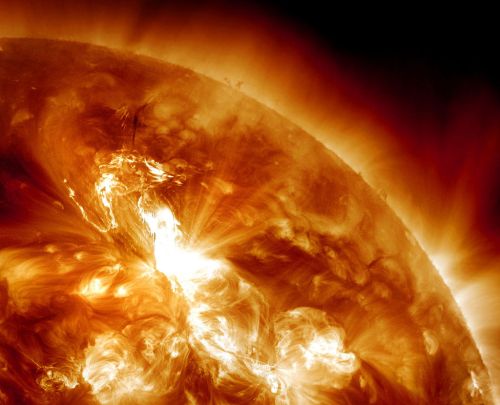
Strongest solar surge in seven years
The Sun’s recent eruption of activity was crowned yesterday by a robust M-class solar flare that could trigger a significant auroral response in regions north of Earth’s 40th parallel before sunrise
Solar activity is definitely on the upswing after a sustained lull that had some experts wondering whether there would be an appreciable maximum to the current solar cycle. Activity is now expected to intensify over the next six to nine months before dropping off through 2013.
X-Ray output from the Sun’s latest flare:

The sunspot that gave birth to the M-9 flare is now rotating into a position more directly facing our planet, so any pronounced outbursts that occur over the next few days will carry increased potential for radio disruptions and even possible electrical overloads on Earth.
On the plus side, Northern Lights (aurora borealis) could be quite impressive given clear skies at northerly latitudes. The risk of serious consequences from this M-9 flare (such as power outages, damage to satellites or even to ground-based electrical equipment, etc.) is low because the Sun’s most active zone is a good distance from its equator. Still, any time that energetic sunspots rotate into view (especially ones with severely twisted magnetic fields) a reasonable degree of caution is warranted.
The great solar storm of March 1989 knocked out most of Québec’s power grid — and a second round of massive explosions on the surface of the Sun in August of that year brought down various electrical systems in Ontario.
 In 1859, the then-recently completed US telegraph network was severely damaged by a solar storm, the intensity of which can only be estimated today. Aurorae were so vivid that people in northern regions were fooled into thinking that morning had arrived. It’s impossible to say precisely how strong a flare it was, but it’s assumed that the disruption to our ionosphere was so profound because the sunspot cluster that spawned the event was directly facing us, casting a massive amount of ionised coronal material from the surface of the Sun squarely in our direction.
Of course, yesterday’s almost-X-class flare could be described as mild when compared with this doozy (below) from November 4, 2003. That flare occurred during a series of eruptions from the Sun that week, some of which are still the strongest solar flares ever recorded with modern instruments. In fact, the week-long storm was so powerful that a new section had to be added to the top of the graph in order to accommodate it. Luckily, much of the output from the storm was not Earth-directed. Had it been, it might have rivaled or surpassed the one that occurred in 1859 — and would surely have had a much more serious impact today due to our reliance on electronic gadgets and upon electricity in general.
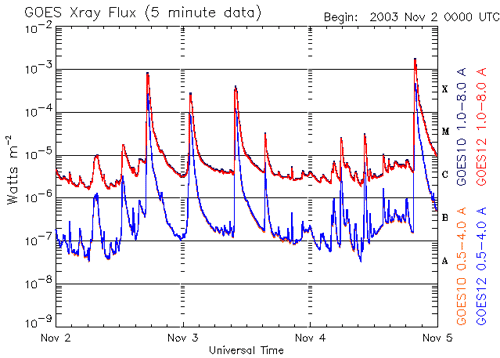
The energy of the flare in the chart above appears to be no more than X-20, but it’s widely agreed that the source data from the GOES satellites were clipped at the top end; the interim consensus rendered a verdict of X-28 with some maintaining that it may have been as high as X-32. Later analysis of the series of explosions led NASA to judge the strength of a flare from October 28th as a whopping X-45. It should be pointed out that, until then, NASA scientists thought that they’d probably never see an X-10. For more on the violent spasm of 2003, see the Smithsonian’s Chandra X-Ray Observatory newsletter, March 2004.
There’s increasing speculation about whether we will see anything close to the magnitude of the November 2003 flares (or the 1859 aurorae) during the next year, but only the Sun can say for sure. And Sol just ain’t talkin’.
Making these sorts of predictions is notoriously… well, unpredictable. The 2003 x-28 mega-flare came at a point in the solar cycle when activity should have been quite low — coming, as it did, more than two years after the solar peak of 2001. So, we’ll just have to wait and see.
Best guess? We’ll probably be discussing this again. Maybe soon…
.
UPDATE
JANUARY 24, 2012 · 11:30 PM
.
The Earth’s ionosphere is still highly energised from a hit that it received courtesy of an earlier, weaker, flare that triggered our January 23rd geomagnetic storm. Technically, that storm is still continuing. It was the product of a more direct encounter with a solar coronal mass ejection (CME).
It’s actually fortunate that the stronger of the two flares did not occur first; the Earth’s pre-energised ionosphere was thereby strengthened against the effects of the subsequent event. It’s also lucky that the main body of the mass jettisoned by the second flare appears to have missed our planet by about 60 million miles.
.

Note: These charts are also available with a black background.
.
 Brilliant displays were sporadically visible in North America’s western arctic region, as well as in eastern Siberia, during the early morning hours Tuesday.
But the real show occurred over northeastern Canada, the northern UK and especially Norway (right) on Tuesday night.
.
Filed under Science
5 Minutes
IT IS 5 MINUTES TO MIDNIGHT
 2012: “The challenges to rid the world of nuclear weapons, harness nuclear power, and meet the nearly inexorable climate disruptions from global warming are complex and interconnected. In the face of such complex problems, it is difficult to see where the capacity lies to address these challenges.” Political processes seem wholly inadequate; the potential for nuclear weapons use in regional conflicts in the Middle East, Northeast Asia, and South Asia are alarming; safer nuclear reactor designs need to be developed and built, and more stringent oversight, training, and attention are needed to prevent future disasters; the pace of technological solutions to address climate change may not be adequate to meet the hardships that large-scale disruption of the climate portends.
The notice above is excerpted in its entirety from the Bulletin of the Atomic Scientists “Doomsday Clock” page. Click the clock to view timeline.


 imahd.ca