

Category Archives: 10 Words or Less
In 10 Words, or Less… Gravity Waves:

Filed under 10 Words or Less, Humour, Science
In 10 Words, or Less… darkEnergy:
“Paradox created by misinterpreting cosmological redshift as Doppleresque waveform decompression.”
—

Hubble ST: The Galactic Field
The ‘Accepted’ Explanation
When we look at very distant objects in space, the light that we see is always to some degree more “red” than it should be. That is to say, the wavelength of the light is longer than expected for the type of galaxy or quasar being observed.
A similar phenomenon occurs when a car drives by with its horn blaring.
As the car approaches us, the sound waves created by the horn are compressed due to the motion of the car coming toward us; i.e. the wavelengths of the sound waves are shorter and the frequency of the sound increases. But, as the car passes by, the waves decompress and the frequency of the sound drops to a lower pitch. The faster the car is traveling, the greater the effect.
The same principle is used in various Doppler Radar devices (though using microwaves instead of sound waves); to measure the radial velocity of storm systems; to find planets orbiting other stars; or to catch you exceeding the highway speed limit.
In space, when a star within our own galaxy (the Milky Way) is moving away from us, the wavelength of its light also decompresses, causing blue light to appear more green (moving toward the redder end of the spectrum). Yellow light becomes more orange. Red light drops into the infrared range.
Within our galaxy, there are examples of both blueshift (object approaching) and redshift (object receding), depending upon the motion of the observed stars relative to our own position. But, when viewing objects outside our galaxy, light waves are predominantly shifted from blue to red. This would seem to indicate that virtually every other galaxy in the universe is moving away from us. These observations ultimately gave rise to the notion of the expanding universe, an idea which then became responsible for initiating the concept of the Big Bang.
By measuring how “redshifted” the light from a distant galaxy is, a determination can be made about the speed at which the observed galaxy is receding from us. Edwin Hubble proposed that the distance to a faraway object is proportional to the speed at which it is receding from our position. In other words, the further away the observed object, the faster it’s moving away from us.
This created some problems initially, since some galaxies (based on “Hubble’s Law”) appeared to be flying away from us at velocities greater than the speed of light; i.e. faster than the universal “speed limit” will permit [strictly enforced]. That misperception was remedied by invoking a relativistic requirement for very distant objects; i.e. when matter is moving at a very rapid rate, the passage of time (for that object) moves relatively more slowly. Though this resolved the problem of galaxies appearing to travel even more quickly than light, it still leaves us with the unlikely conclusion that a few galaxies (very far away from us) seem to be moving at something close to 90% of the speed of light.
So, “dark energy” was theoretically proposed to be the driving force behind the incredibly-rapid, but logically-deducible, expansion of the universe.
—
An Alternative (Heretical) View
The simplest solution often being the best, let’s look at cosmological redshift in a completely different way.
In classical mechanics, when an object moves at a given velocity between one point and another, that object has momentum, which is the product of its speed and its mass. Since light has no mass, it is commonly believed that light must have no true momentum. However, if we accept that light does have a special kind of momentum, which we can call effective momentum, then we can see its waveforms in a whole new “light”.
When blue light (having a short wavelength) passes through our atmosphere, it scatters more than red light (with its longer wavelength) does. The blue light can be said to be more materially interactive. Similarly, when discussing light refraction, as through the medium of a prism, blue light bends more than red light. The shorter the wavelength of the light, the greater the refraction. In response to a source of strong gravity, shorter wavelength (bluer) light reacts more like a material particle, its trajectory being altered by the gravity source more than its longer wavelength (redder) cohorts; though, to the observer, the light will become bluer or redder depending upon whether the observer is standing closer to–or further away from–the gravity source.
If bluer light displays more mass-like properties (is more materially interactive), then it can also be considered to have a higher effective momentum even though it has no true mass.
If we take the next step and view cosmological redshift (the reddening of light over the vast intergalactic distances) as the result of light’s declining effective momentum, then we would not be required to accept that some galaxies are zipping away from us at speeds perilously close to that of light.
Though the speed of light remains constant, the energy density at the observed wavefront declines according to the inverse square law. Energy being equatable with mass, this leads to a degradation of light’s effective momentum along with a corresponding transformation of the waveform to a lower frequency / longer wavelength.
Light is supremely efficient. It always finds the shortest route in its journey between two points – which is often not a straight line, owing to the way that gravitational influences curve space and flex time. At the primary origin (source) of light’s emanation, its waveforms are a model of efficiency, being integrally dependent upon the energy output of the process that creates them. High energy reactions emit short (high density) waveforms; e.g. gamma rays or x-rays. Low energy reactions emit longer (lower density) waveforms; e.g. microwaves or radio waves.
As light travels over extreme distances, its energy density declines and its effective momentum falls, which leads to a naturally contingent change in the waveform’s signature. (Think Planckian locus.) And, because light never completely loses its momentum (unless it stops being light), wavelengths will gradually grow (and redden) until they eventually fall below perceptible limits.
Of course, taken to its logical end, this means that there actually was no “Big Bang” and that the universe is not expanding — though it may very well be oscillating.
But maybe we should leave that discussion for another time…
© 2009
Filed under 10 Words or Less, Science
The Advent of Monolithic Man
The word ‘monolith’ denotes something that is massive and uniform. As such, it can be applied to anything from a large, continuous piece of stone to a person of towering, unique intellect – someone who stands alone in his or her field of endeavour. In the latter case, there is perhaps no more perfect an example than that of the late professor Albert Einstein.
Had he not existed, we would not have GPS systems because the satellites can only be coordinated using the principles enshrined in his theories of Relativity. We might not even have television because he was the one who defined the photoelectric effect. Let’s not even tread into the more esoteric worlds of gravitational lensing, Bose-Einstein condensates, or the Einstein-Podolsky-Rosen paradox.
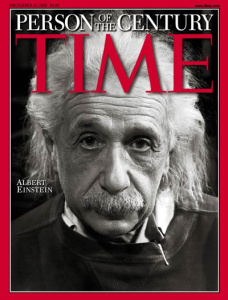 At the conclusion of 1999, Time magazine declared him to be the Person of the Century. FDR and Gandhi were mere runners-up.
Whether a matter of sheer coincidence or some bizarre manifestation of destiny, the name Einstein may have held a clue about the potential of this singularly impressive individual.
EINSTEIN =
EIN + STEIN (German) =
ONE + STONE (English) =
MONO + LITH (Latin) =
MONOLITH
A note about the cover shot from Time:
The iconic image of Einstein on our cover was taken in 1947 by the legendary photographer Philippe Halsman. Einstein was not fond of photographers (he called them Lichtaffen, or light monkeys), but he had a soft spot for Halsman. Einstein had personally included the photographer on a list of German artists and scientists getting emergency U.S. visas to evade Nazi capture. Halsman recalled that Einstein ruminated painfully in his study on the legacy of E=mc²: talk of atomic war, an arms race. “So you don’t believe that there will ever be peace?” Halsman asked as he released the shutter. Einstein’s eyes, Halsman said, “had a look of immense sadness…a question and a reproach in them.” He answered, “No. As long as there will be man, there will be war.”
Most people don’t have the time or patience required to understand the physics of Einstein, so I’m posting this practical explanation of what could be called Basic Relativity, as opposed to Einstein’s Special or General theories of Relativity.
It was derived in very much the same way that Einstein initiated his own theories – through rigorous, logical thought experiments and a healthy dose of creative intuition. (Generally, for Einstein, the formal mathematics to support his theories came in the secondary stage of his theoretical explorations.)
So, here’s a straight-forward, logical statement on Relativity (in 10 words or less) that doesn’t break any physical laws and which can even be seen to underpin many of those accepted rules – including the absolutely fundamental inverse square law. The principle (along with a simple mathematical proof) was developed by an amateur cosmologist in 2005.
Steinman’s theorem simply states:
“Matter is to energy as time is to space.”
—
Proof:
matter : energy = time : space
m : e = t : s
m / 1 : e / 1 = 1 / v : v / 1
(v is velocity or acceleration)
e = mv²
(in the ultimate case, e = mc²)
—

~
UPDATE: December 1, 2009
In response to requests for additional information on this topic, here is an addendum posted by Mr. Steinman to a related IOP [Institute of Physics] discussion group thread on LinkedIn…
~
I can fully understand that it’s difficult to grasp the concept:
“Matter is to energy as time is to space.” ~ But that’s the way things work.
In Gary’s [Dr. Navrotski’s] earlier response, he cited E(k)= ½mv² (the kinetic energy of a rigid body in motion) which aligns perfectly with Einstein’s Relativity. (Note: It is “½m” because the other half of the mass would be contributed in any collision by the body which is struck, à la Newton’s Third Law.)
The key to my challenge [as defined in the IOP discussion] was the word “absolute”, since this is when c embodies the most acute aspect of the accelerative component and reveals itself as absolutely central to nuclear reactivity.
Though the matter of “why” is addressed in the logical statement, the following may help to identify “how” c creeps into the calculation:
In a four-variable equation, you need to resolve at least two of them in order to extract any significant meaning.
The first thing to test is an absolute. Ideally, you’d want to interject a constant that satisfies two of the four variables.
There’s only one universal constant ( c : speed of light in vacuo) that applies to two of the four variables (in this case, time and space) without any need for statistical uncertainty (in Newtonian G uncertainty is 1.0 x 10^-4; the Planck and reducedPlanck constants have an uncertainty factor of 5.0 x 10^-8).
So, plug in the appropriate, defined, universal constant ( c ).
But you can’t plug c directly into both the Time and Space placeholders without a very minor adjustment:
For Time, it must be stated as the amount of time required for light to travel one standard unit of distance ( 1 / c ). For Space, it is the distance traversed by light in one standard unit of time ( c / 1 ). This reflects the interrelated nature of space and time as a true continuum.
This works regardless which set of standard units is used.
(Note: It may help to view time as latency; how fast something DOESN’T happen.)
After cross-multiplying the equation, you get e = mc², which conforms precisely to Einstein’s Relativity principle for mass-energy equivalence.
The nine-word statement (“matter is to energy as time is to space”) can serve as an answer to the original question (Why c² in e = mc² ?) or it can be viewed as a description of Relativity in its most fundamentally naked form.
While the logic of equating m/e to t/s will seem completely obtuse to most readers, the simplicity of the proof is inescapable.
Simple, but not overly so. (Some do find it maddening.)
Viewing things through the prism of “matter is to energy as time is to space”, you will find that none of the established laws are broken ~ only gently bent.
© 2009
Filed under 10 Words or Less, Reason, Science

 imahd.ca