Category Archives: Arts

The Resettlement of Khuzestan

Here’s a letter that came by way of the British Ahwazi Friendship Society.

In it, Mohammad-Ali Abtahi, former Chief Secretary of former President Khatami’s Office, details a plan by which the majority Arab population of the oil-rich province of Khuzestan can be reduced to less than a third of the current regional demographic; a planned relocation of about 1.25 million people. During the past ten years (the end of the target window for the program), few Ahwazis have agreed to be moved, but their majority status in Khuzestan has been eroded by a steady, government-sponsored influx of Azeris and Persians. Translation follows:

abtahi

Translation:

Emblem of the Islamic Republic

ISLAMIC REPUBLIC OF IRAN

Office of the President

Head of the Executive Office

Number Date Attachment 5/316/20675 (hand written)

TOP SECRET


In the Name of Allah

Head of the respectful Department of planning and budget- Mr. Dr. Najafi

With greetings:

Pursuant to the policies set forth, and the legislation approved by the National Security

Council, with regards to changing the population demography of Arabs of Khuzestan and their appropriate resettlement to other parts of the country, it is necessary that the attached approved instructions be directed to all relevant subsidiary organizations for execution.

1. The Arab population of Khuzestan must be reduced to a third of the total population of

Khuzestan within 10 years, with the rest of the population to be composed of Farsi-speaking residents and migrants.

2. On the resettlement of other ethnic groups, especially the Azeri (Turks) to Khuzestan

province, in addition to the facilities approved under legislations # 16-32/971/5-7, dated

14/4/1376 (July 5, 1997) – other arrangements have been made to facilitate this (forced resettlement) which will be announced in the future.

3. It is necessary to increase the resettlement of their (Arab) educated class to other provinces, especially to Isfahan, Tehran and Tabriz.

4. Proof of the existence of this ethnic group (Arabs) should be eradicated, including the

changing of remaining (Arabic) names of cities, villages, regions and streets to Farsi names.

5. Arabic-speaking people should be used for the execution of this legislation, although the secrecy of this programme must be respected.

6. Newly approved legislation regarding the (forced) migration of (university) students, civil servants, teachers, military and security forces and farmers to other provinces, are attached.

Signature

Sayed Mohammad-Ali Abtahi

TOP SECRET 27686/62 2/5/1377 (July 24, 1998)

Carbon Copy:

1. Ministry of Information (Security)

2. Ministry of Interior

3. Ministry of Housing and Urban Development

4. Ministry of Culture and Islamic Guidance

.

And I thought that President Khatami was considered a ‘moderate’?


2 Comments

Filed under Chicanery, Conflict, Words

EMM – Earth, Moon, Mountain

emm

Earth image (in foreground) adapted from original image by Heikenwaelder Hugo, Austria under Creative Commons Attribution ShareAlike 2.5 license. The same license applies to this image, Author: imahd.wordpress.com

Leave a comment

Filed under Arts, Images

The Syrian ex-Nuclear Site

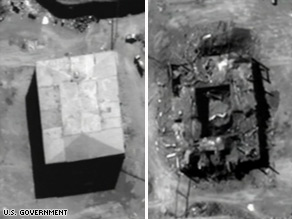
The following is a collection of images taken during (and after) the construction of the Syrian facility bombed by Israeli commandos on September 6, 2007. 


syrian_reactor_before_afterThe images at right show the central building of the Syrian site before and shortly after the Israeli strike. 

Just after this satellite image capture, the Syrians bulldozed the site, poured a concrete foundation over the ruins and constructed a new building on top of the original. Even so, they have been unwilling to allow soil samples to be taken by the IAEA (International Atomic Energy Agency). 


Here’s a wider view of the building and site which is less than 1 km from the Euphrates River; a location ideal for the cooling requirements of a reactor:

before


Here’s a view of the period after the mission, with the main reactor building flattened by bulldozers:

after


Here’s the main building under construction before an external sheath was installed to disguise the reactor’s key features:

syria_nuclear_01


Inside the building. Here we can see the rebar put in place for the pouring of the cement to create the facility’s central cooling tower:

KOREA-NORTH/USA


The steel reactor liner with cooling tubes:

KOREA-NORTH/USA


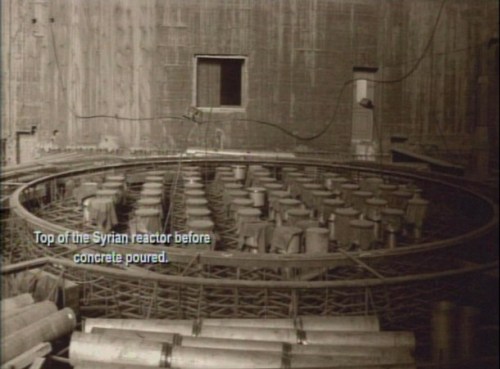
Top of the reactor prior to concrete being poured:

KOREA-NORTH/USA


The innocuous looking exterior:

show3


Another innocuous building; this one in Yongbyon, North Korea:

FE_DA_080425korea


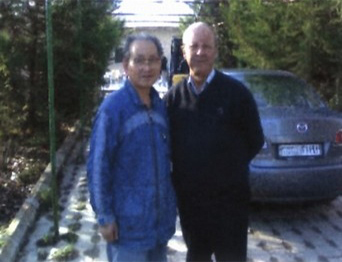
Head of the North Korean reactor fuel plant with the head of the Syrian Atomic Energy Commission, in Syria:

SYRIA-NKOREA-NUCLEAR-WEAPONS-US-INTEL


New building going up at the site of the former Syrian nuclear reactor complex:

syria07_666_475917a


ISIS Report – October 23, 2007 (PDF – 1.2 MB)

2 Comments

Filed under Chicanery, Conflict, Images

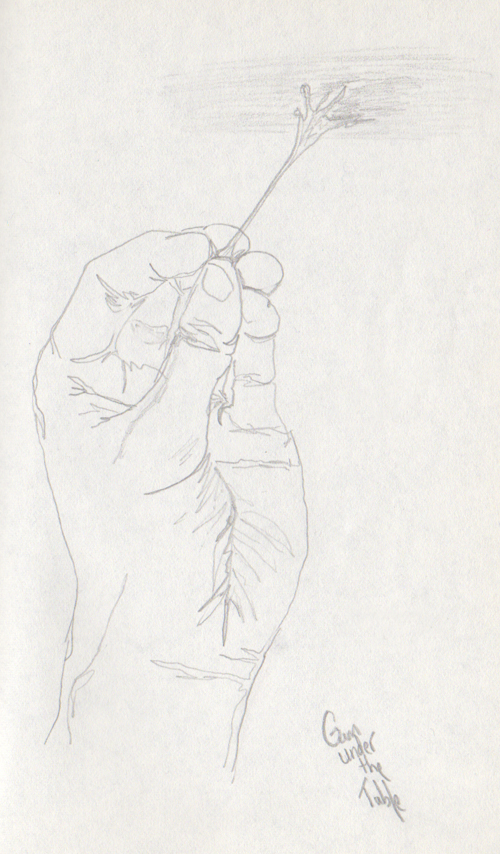
Gum Soul

gum

© 1980

Leave a comment

Filed under Arts, Images, Life

Origin of the Rigveda

(Note: Yes, the image below is not from the Rigveda, but from a Nepalese Devimahatmya palm leaf scroll. Just intended to demo a little Sanskrit.)

sanskritThe Rigveda is the oldest extant collection of Vedic Sanskrit hymns and was composed during the early Vedic period (1700 – 1100 BCE) by the Rishis (sages). It was during the earliest portion of this era that Abraham/Ibrahim was traveling through the Indus Valley region.

Accordingly, both the words, Rigveda and Rishi, have related Sanskrit/Hebrew roots. In Sanskrit, Rigveda is a compound of the roots “rc” (“praise”) and “veda” (“knowledge”). In a Semitic twist, we also see that the Hebrew root compound means very much the same thing.

The Hebrew root “reg-” means “festival”, as in the word “regalim” (“times” or “festivals” [of praise]). As a rule, a festival is always held at a specific point in the yearly calendar, hence the use of the root “reg” to also imply “time”, “measure”, “standard” or “rule”; this later carried over into both Greek and Latin. The meaning of “veda” in Sanskrit is precisely the same as for the Hebrew word “yedda” (knowledge).

The Sanskrit word “Rishi” (sage[s]/seer[s]) is equivalent to the Hebrew word “arshim” (sages). In fact, there are a number of examples of words with the Sanskrit root “rish” that translate directly with Semitic words with the root “arsh”.

The Rigveda begins with the Hymn of Creation. Below, you can see how similar it is in its ex nihilo premise to Genesis 1 (b’reshith aleph) of the Hebrew Bible.

The Creation Hymn

A time is envisioned when the world was not, only a watery chaos (the dark, “indistinguishable sea”) and a warm cosmic breath, which could give an impetus of life. Notice how thought gives rise to desire (when something is thought of it can then be desired) and desire links non-being to being (we desire what is not but then try to bring it about that it is). Yet the whole process is shrouded in mystery.

Where do the gods fit in this creation scheme?

The non-existent was not; the existent was not at that time. The atmosphere was not nor the heavens which are beyond. What was concealed? Where? In whose protection? Was it water? An unfathomable abyss?

There was neither death nor immortality then. There was not distinction of day or night. That alone breathed windless by its own power. Other than that there was not anything else.

Darkness was hidden by darkness in the beginning. All this was an indistinguishable sea. That which becomes, that which was enveloped by the void, that alone was born through the power of heat.

Upon that desire arose in the beginning. This was the first discharge of thought. Sages discovered this link of the existent to the nonexistent, having searched in the heart with wisdom.

Their line [of vision] was extended across; what was below, what was above? There were impregnators, there were powers: inherent power below, impulses above.

Who knows truly? Who here will declare whence it arose, whence this creation? The gods are subsequent to the creation of this. Who, then, knows whence it has come into being?

Whence this creation has come into being; whether it was made or not; he in the highest heaven is its surveyor. Surely he knows, or perhaps he knows not.

wsu.edu

The tone and approach are different from Genesis, but a good part of the story is the same. The original story of the creation was passed down orally from Adam and later recorded by Abraham as part of the Book of Formation (Sefer Yetzirah — which answers many of the questions posed in the vedic hymn). Many years later, it was reconstituted by Moses at Sinai in both an Oral and Written form.

It’s now likely that you will think of Abraham/Ibrahim the next time you hear the words “brahma”, “brahmana” or “brahmin”.

If you are Hindu or Buddhist, please take no offense. It only means that we are all indeed brothers. And, if you are Daoist, you’re not getting off scott-free; turns out Lao-tse may also have been a Jew who traveled to southwestern China from the expanding Medo-Persian empire.

For further reading on this slant, you might want to check out this cached link, “Indian Abraham” (the original seems to have gone missing). Some erudite work done there. I can’t subscribe to all of it, but it is, nonetheless, an excellent read. And maybe an eye-opener for some.

And then there’s Dr. Ken Biegeleisen’s 1994 book, “Whoever You Thought You Were… You’re a Jew!” But, Dr. Ken is not just a theo-social commentator; his paper on Circular DNA is most definitely worth checking out.

2 Comments

Filed under Esoterics, Words