Category Archives: Conflict

Where’s Osama bin Waldo?


osama-waldo_sm2

Pakistani president Zardari said Tuesday that he believes Osama bin Laden may be dead, but US officials insist that he’s still alive – and, apparently, he’s just as elusive as ever. 

Here’s a sensibly irreverent 2006 report on the new millennium’s most famous Waldo. Thanks again to VizReport for opening up its archives. (“BinWaldo” image: About.com – Political Humor)


Echoes of Graceland: 
The Bin Laden Sessions 

February 20, 2006 

alvistxt (VizReport) Like Elvis fans at the gates of Graceland, so are the media at the portals of Al-Jazeera; hopeful of gaining a glimpse of something strange and elusive. Something almost mythical.

But it’s a circus. It’s not real. Let’s all just admit that Osama bin Laden is dead and forego the introduction of any more audiotapes. The quality is just brutal anyway — and no amount of digital remastering is going to make them sound any better. 

Okay, they’re doing a fair job on the marketing end. I’ll grant them that. While Elvis’ career started with tape recordings and proceeded to films, Osama’s people have decided to come at it from the other end. Smart. In today’s MTV universe, any producer worth his pillar of salt knows that you just don’t bring a new talent to the world stage without a video to hype the product. 

They did everything right at the beginning. Osama was hot. He had a video. He had some solid tracks. All the ingredients were there. But then, as with so many popstar careers today, the focus got soft, the quality started to suffer. 

Even if you have a hot commodity, like a ’50s Elvis, or a poetry-spouting millennial Osama, you still have to protect and expand your brand position through the implementation of an effective quality control program. Is there an ISO standard for terrorist operations? 

Probably not. (At least, I hope not.)

The quality of the lyrics has gone downhill since late 2001, when Osama met up with Elvis (so to speak) in a Tora Bora mountain cave. There’s a great parable in there somewhere… something about “the mountain coming to Osama”. Well, it’s not like it had to travel very far; it only had to drop a couple of feet. 

But this is about more than dreadful lyrics. It’s a matter of “presence”. The new Osama, played by his eldest son, Sa’ad, is living proof that there’s no such thing as a dominant gene for charisma. Can you imagine how happy AQ#2 Ayman Zawahiri was when he discovered that the kid’s voiceprint was similar to his late Dad’s? But then, to his chagrin, he learns that the boy just doesn’t understand the whole “Mahdi” thing. And it’s not like you can just send him off to any old school for lessons. This is esoteric stuff. 

“We’ll fix it in post,” Zawahiri is now frequently overheard to say at their recording sessions. 

Post-production consists of taking the studio cut, back-masking it with a track of chickens being mechanically deboned, recording it to a cassette, and from there onto an 8-track, stamping the cartridge into the hard, dry ground several times, dubbing it back to a cassette, pulling the tape out by hand onto the dusty floor, before finally rewinding it back onto the spool with a pencil. 

At this point, you’d think that the voices of Osama and Sa’ad would be indistinguishable from one another, but they’re not. They might be able to fool a machine because a machine only knows the percentile correlation of digital patterns. It can’t hear the “spirit” of the tape ’cause it’s got no soul. 

Elvis had soul. Osama did, too. He didn’t rock out like the King, but he could deliver his lines. He threatened to put the “boogie” back in boogeyman, but he is no more and his body is unrecoverable; a fact that bothers many who are seeking closure, but a source of endless possibilities for both Al-Qaeda and the U.S. administration. 

For those conducting the Jihad, they have an untouchable hero. And for those prosecuting the War on Terror, there are endless leads to track down in the field, as well as continued funding from Congress. Osama may be lost, but so many will not let him be forgotten. 

Bin Laden Video Sept 11 AnniversaryThey tried a stand-in for Osama in early 2002, but that didn’t work too well. The guy’s nose was too flat, and even when they backed the camera up until he was taking up just 10% of the screen, you could still see that it wasn’t Osama. 

My personal opinion is that they should’ve been better prepared. The terror market is a killer. They knew that! It’s got a higher attrition rate than rock stars who are foolishly permitted to drive the tour bus, or worse… fly the plane. 

No one seems to accord the general population much credit for common sense. When the average guy can record a decent quality video on his cellphone, why is Al-Qaeda still sending messengers on a hazardous journey across many lands to the peninsula of Qatar where an archaic tape is dropped into a mailbox just across the street from the head offices of Al-Jazeera? The quality would be higher using an internet-compatible cellphone (it couldn’t be any worse) — and it could be e-mailed there in minutes. 

The answer is simple and obvious: He’s dead. 

But this enduring drama may soon be drawing to a close. In his latest tape, “Osama” says that they’ll never take him alive. A bold-sounding statement, but an excellent bet! 

This apparently comes from the same tape as some earlier excerpts that were released by Al-Jazeera on January 19th. Among the highlights in that speech was the usual promise of new attacks against America. 

Killing a dead guy is, at the same time, the easiest thing in the world to do, and the most difficult. It bothers me that Osama’s people are saying that he may soon be dead, as that might herald a dangerous shift in strategy. 

But maybe he’s not dead after all. I hear that Barry Manilow just released some new material, so I guess anything’s possible.
 

kc9oz72There won’t be anymore videotapes unless Peter Jackson is hired to direct the next one. It’s tough to sneak things by a sophisticated video-viewing audience. The best rendition of Elvis that I’ve seen in a long time was the performance by Bruce Campbell (of Evil Dead fame) doing a top-notch “Retirement Home Elvis” in the camp horror flick, Bubba Ho-tep.
Leave a comment

Filed under Chicanery, Conflict, Humour, Images

Still Not Funny

“We’ll laugh about this when we’re older,” people are fond of saying after going through a rough patch together. But is it true?

Apparently not when it comes to cartoon images of the Islamic prophet Mohammed. 

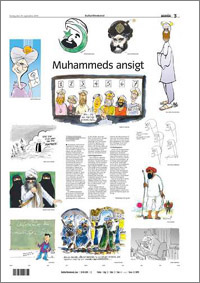
Denmark cartoonist Kurt Westergaard’s unflattering portrait of the prophet capped by a bulbously bomb-laden, fuse-lit turban appeared alongside eleven other similarly-topical, debatably-comical entries in the Jyllands-Posten newspaper in September of 2005.

He is apparently now trying to sell numbered prints of his work over the internet. 
 

Here’s a Flashback from early 2006, courtesy of VizReport:

Khartoons 
Apparently, Not a Laughing Matter 

February 10, 2006 (Photo: wikipedia) 

muhammadpg (VizReport) How can pictures printed in a Danish newspaper last September be causing such massive upheaval today? 

It seems that a lot of people are confounded by the protests (some of them violent) that are currently raging worldwide against cartoons depicting the Islamic prophet Mohammed. 

The whole thing appears to have started when Danish author Kåre Bluitgen had a tough time trying to find someone to illustrate his children’s book on the life of the prophet. When the matter came to the attention of the cultural editor of the Danish newspaper Jyllands-Posten, Flemming Rose, he contracted twelve different artists to provide their own visual interpretations of Mohammed for a commentary on the basic problem faced by Bluitgen. 

Well, things quickly spiralled out of control; ambassadors were recalled; envoys were expelled; the Libyan embassy in Denmark was closed; apologies were issued; boycotts against Danish goods were initiated; dramatic demonstrations were held; more newspapers printed the offending images; apologies were issued; and several political cartoonists went into hiding. 

Did I mention that apologies were issued? In fact, the management of Jyllands-Posten apologised before widespread protests even broke out. Most of the other newspapers that re-printed the pictures have also since apologised. However, few apologies will be forthcoming from Western governments (as demanded by many protesters) because the press in the West is generally free from direct government control. Things are very different in a number of Muslim majority countries where freedom of the press is usually subject to the wishes of the ruling party. 

On a religious basis, there are two very different reasons for the cartoons to have caused a fuss: 

1) Idolatry – Any depiction that is flattering runs the risk of becoming an icon for worship. This is directly descended from the Book of Exodus, the second of the five books of Moses. 

Actually, the verse (Exodus XX; the basis of the Ten Commandments) doesn’t say that one shouldn’t draw pictures of prophets — it says that one shouldn’t draw pictures. Period. 

This is a difficult concept for us to imagine in our image-saturated world. 

Geometry is okay. Words are okay. But no pics. 

2) Blasphemy – Following right along into the next commandment: Don’t take the Lord’s name in vain. 

This, I imagine, would also include defaming the Lord, or the word of the Lord as faithfully presented by his prophets, or his faithful prophets…in that this would reflect on the perception of the Lord’s word. 

The extension to the basic precept opens the door to potential offense if everyone is not in complete agreement on an “official” list of prophets. 

On a sociological level, it’s easy to understand why people fervently devoted to Islam could be upset with some of the images. There’s no doubt about it; some of the pictures and commentary could be considered anti-Islamic. Most of them are in poor taste, to one degree or another. That has definitely provided the emotional impetus to get people out the door to protest. 

But this is about more than just a few ill-conceived cartoons. It’s an expression of the pressure and desperation that is building in the world. 

It’s also about the objectives of several groups that seem reticent to allow this unfortunate episode to progress to its most logical and productive resolution. I can’t tell you why some people see it as their job to fan flames wherever they find them. Some even carry matches. Others, gasoline! 

Well, that would certainly explain the burned-out embassies and consulates. 

islm_cartoon_3aThe best cartoon of the lot (by Arne Sørenson) goes directly to the heart of Bluitgen’s dilemma. It depicts an artist sweating nervously as he surreptitiously works by low light, windowshade drawn, on a picture of what we are told is Mohammed. 

This is an image with humanity. It doesn’t disrespect anyone’s religion, but comments effectively on a bizarre situation faced by professionals who normally create graven images without a second thought. 

It may be impermissible for reverent Muslims to respectfully portray Mohammed in pictures, but the same does not necessarily hold true for non-believers. And even if it did, it is also a fundamental tenet of Islam that the punishment should fit the crime…but not in the way that Iran has attempted to turn the controversy in their own favour, by organising a cartoon competition. Topic: The Holocaust.

Perhaps someone can point out for me exactly where in the Qur’an it says that two wrongs make a right.

5 Comments

Filed under Arts, Conflict, Images, Life

9/11: Back to The Future

By popular demand, and courtesy of VizReport and Graphic Exchange magazine, we have resurrected this bizarre collection of media exposures that, viewed in hindsight, appear to presage the fateful events of September 11th, 2001.

(Originally printed October 2001 in Graphic Exchange magazine with the title “Your New World Order has arrived… and it’s a combo platter.”)

The 9-11 Pre-Echo Gallery
Graphic Exchange: October, 2001; VizReport: March 14, 2006

It’s not unusual for us to recall significant events from our past, but it’s certainly less common (one might even venture to say that it would be remarkable) to recall moments of great impact from our future.

combo22However, that’s exactly what appears to have happened to hundreds–maybe thousands–of people in advance of the September 11, 2001, terrorist attacks. While countless people dreamed of those events in the days prior to their ultimate unfolding, there also exists a catalogue of media products (created in the months prior) that chronicle the story in chilling detail.

Insofar as the arts community is more acutely attuned to imagery than the average citizen, it’s not surprising that they would be more likely to experience and recall pre-cognitive images and themes that might occur to them in sleep or other moments of reverie. It’s also understandable that since their occupation involves the creation of images, that these themes would migrate into their everyday work.

Let’s examine some of the more startling examples of this phenomenon.

egyptcalMark that Calendar
It would be easy to assume, especially since the calendar shown here was produced in a primarily Muslim country (Egypt) and the text says something about laying down one’s life for Allah…and the picture shows an aircraft crashing with the NYC skyline in the background…and the month shown is September 2001…that the creators of this art might have had some foreknowledge of the events to come.

This may not be the case — even though the piece was printed in May of that year, several months in advance of 9-11 — because this is far from an isolated instance. Examples of such mysterious insight come from all across the globe.

Granted, most of the other examples didn’t feature quotations extolling martyrdom, but they did come close to exposing the entire plot before it even occurred.

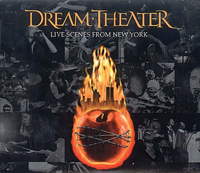
dreamtheater“Live Scenes from New York”
The popular progressive rock band, Dream Theater, released this CD at around the same time as the attacks, but the artwork was put together the previous Spring.

The cover art depicts a literal “Big Apple” in flames, with the Twin Towers prominently displayed in the midst of the fire. The monotone-gray background of the image is so reminiscent of the charred and dusty ruins that we’ve all come to associate with Ground Zero.

The CD was subsequently released with the band’s logo in the central position on the cover, rather than the original controversial image.

teletriesteTwo Twins in One
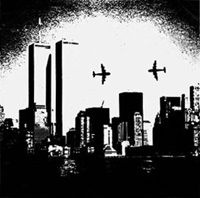
The artwork for German band Tele Trieste’s 2001 CD (label: Insekt Angelica) was already on the market when the planes struck the WTC and the Pentagon. The design was essentially completed during April and May of 2001. The CD released: June, 2001.

The Twin Towers are central to the theme of the work, as are the two planes, which appear to be on a collision course. The CD contains the recording of a live session from April 7, 2001, but the year is given as 1462.

trieste-textLater, I found the following… The year 1462 was the birth year of both renowned German cryptographer Johannes Trithemius (speaking of hidden messages) and Louis XII of France. Curiously, it was also the year in which Vlad III of Wallachia (Dracula) was defeated and deposed by the Ottomans. He would rise again to rule for less than a year in 1476, but would die shortly after regaining his Transylvanian throne. It is worthwhile noting that Vlad, despite his infamous proclivity for extreme violence (especially for impaling his victims), was not only a central figure in the crusade against the Islamic Ottoman Empire, but was widely credited with halting the spread of Islam into Europe.

coupA Highly Explosive Pre-Echo
Meanwhile, back in North America, The Coup was working on their new release, Party Music. Two members of the hip hop team are depicted choreographing the destruction of America’s ultimate symbol of capitalism, the World Trade Center.

The explosions on the towers even appear to be occurring at the same relative positions at which the ill-fated planes would later impact the structures. The cover art would be revised before the CDs were shipped, but the graphics were completed in May and June of 2001.

healing2A Sombre View
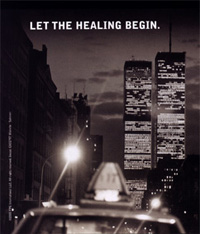
This ad was placed in Canadian industry publication Graphic Exchange by a stock photo agency. While the aim was to invite people to recover from the use of poor photographic stock imagery, the eventual context in which it would be viewed lends it a definite air of prescience.

One anguished reader wrote the publisher to complain about the ad, which seemed to be callously using the tragedy to sell photographic images, and only later realised that the issue pre-dated 9-11 by months.

The publisher is still spooked by the odd timing and the particular choice of image, which, like the background of the Dream Theatre CD art, is so gray and sombre.

It’s not odd that the WTC structures would be featured in so many images because they were among the most photographed buildings in the world. However, the range of images created during this timeframe uniquely tend to have either explosive or ‘memorialistic’ themes.

mibsA Cartoon Becomes Less Funny
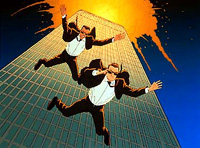
This is an animation frame from Men in Black: The SeriesEpisode 50.

Columbia Pictures’ own website carries the following plot outline:

50. The Breaking News Syndrome
Agent X has taken the liberty of inviting an interstellar version of the show COPS to come and film him in action. Zed takes back X’s liberties, and assigns the camera crew to film Agent Kay instead. Meanwhile, Drekk’s back on Earth, and he’s ready for his close up as well.

The summary neglects to mention that a battle takes place atop Building 2 of the WTC, during which parts of the building are destroyed. Agent J surprises Drekk (the villain) with a water cannon and Drekk is blown off the building by the water. When the camera crew asks Agent J why he initially appeared on the wrong building, he casually responds, “Really, I was on the right building. It’s a little sneak attack manoeuvre I like to call 9-1-1.”

Episode first aired: May 12, 2001

The Remote Guidance Plot
One of the most shocking pre-echoes, for me, was the pilot episode of the short-lived X-Files spin-off; The Lone Gunmen. The storyline reveals a plot to fly a commercial jetliner into the World Trade Center. Although I do agree that remote control was used in the actual attack, I don’t necessarily subscribe to every aspect of the plot as scripted.

The show outline was written in late 2000 and the actual pilot first took to the air, so to speak, on March 4, 2001, on the Fox Television Network. (Critical scenes begin at 29:00)


This excerpt is herewith included under the fair use provisions of the Copyright Act as an integral and newsworthy aspect of our examination of this incredible pre-cognitive phenomenon.

But… How can this be?

As is evident from many of the 9-11 sites I’ve explored on the Web, some people would obviously prefer to believe that there’s a massive media conspiracy to cover up its own involvement in this nefarious work with one hand, while rubbing our noses in it with the other. Conspiracies obviously do exist, but the examples provided here may not be evidence of one.

However, these images may be proof of something else entirely.

2 Comments

Filed under Arts, Conflict, Esoterics, Images, Life, Music, Video

DPRK: N-Test, Take 2

It was early October, 2006. Overhead, satellites skimmed the sky above the Democratic People’s Republic of Korea (DPRK) and took careful note of the goings-on below.

On the ground, as well as far beneath it, technicians busily prepared for North Korea’s highly-anticipated, first nuclear weapons test – an event that was confirmed in dramatic fashion on October 9th, when it appeared on one of the seismographs I was monitoring:

10-08-06 QIZ_24hrThough the event appeared on dozens of other seismographs, this one, from seismic station QIZ in Guangdong, China, seemed particularly interesting.

In the lower-right corner of this QIZ seismograph, you can see the “boom” of a large, explosive detonation. In comparison to normal seismic activity (seen in the middle section of the graph) the explosion created a much less jagged seismic ‘signature’ than a standard earthquake when it rolled into Guangdong. On other seismographs, the North Korean “bang” looked similar to a normal earthquake (except for its abrupt onset), but QIZ sits in a sort of sweet-spot when it comes to catching ‘vibes’ from North Korea.

Estimates of the test’s yield varied from 0.5 to 15 Kt (kilotons); the former figure coming from a US arms expert and the latter having been issued by the Foreign Minister of the Russian Federation. A consensus developed, at least in Western circles, around the idea that the DPRK’s nuclear test had released energy equivalent to just over 800 tons of TNT (0.817 kT) – a relatively small bang in nuclear terms, but a concern nevertheless.

The US Pentagon officially considered the test to be “fizzle”, which is to say that it produced a yield substantially less than intended, but there was a lot of discussion in the media (and in “situation rooms” worldwide) about the actual meaning of the event.

Here’s the signature of the test, statistically smoothed:

1st-testnk

States of Alarm
On October 11th, 2006, shockwaves of another variety rocked the debate when an earthquake prompted many to believe that another (larger) test had just taken place. (A quick review of the seismic data took the tension down a few notches.)

A couple of days later, the US confirmed that, according to air samples collected on October 11th, North Korea’s Oct. 9th detonation had indeed been a nuclear one. (Tension climbs back up – one notch.)

On October 16, 2006, the governments of the United States, Japan and South Korea simultaneously indicated that preparations for a second nuclear test were underway and that the test was likely imminent. (Two notches!)

And then… nothing. The days ticked by…

On October 18, 2006, the technicians on the ground seemed to be packing up and moving on to other duties, but no one seemed to know exactly why the seemingly imminent second test had been cancelled or postponed. There were, undoubtedly, some who took the opportunity to congratulate themselves for having bent the will of North Korea’s intransigent leader (and master prevaricator) Kim Jong-Il.

Meanwhile, North Korea quietly informed China that it was intending to conduct as many as three more nuclear tests.

But what happened between October 16th and October 18th?

Why, October 17th, of course!

And this:
10-16-06 QIZ_24hr

– a strong quake (R6.6); Papua, New Guinea region; as measured at QIZ

Most of the activity seen in the graph above is due to a strong earthquake (R6.6) that took place on October 17, 2006, near Papua, New Guinea (P.N.G.). However, in the midst of the recorded tremor there are some anomalies.

None of the other available seismometers showed the same sort of alternating signal cancellation and augmentation that can be seen in this graph from the QIZ seismo – the same seismometer that rendered the most unique “echo” of the October 9th nuclear test.

So, I had an idea:
What if I took the signature from the Oct. 9th test and compared it against the anomalies in the Oct. 17th seismograph?

A strange thing happened when I scaled the earlier signature by 245% (about six times the energy displacement of the Oct. 9th test):

abcd1

The first peak of the previous signature (in Red) aligns perfectly with the maximum signal cancellation in the P.N.G. quake at Point A.

At Point B, the P.N.G. quake (but only when measured at QIZ) undergoes another transition.

The climb to the second peak (Point C) of the first signature coincides with a strong augmentation of the P.N.G. data.

At the next peak, Point D, the P.N.G. seismographic data suddenly changes once again.

Statistically speaking, the strong correlation between the two signals dramatically increases the likelihood that a second North Korean nuclear test did take place – eight days (almost to the minute) after the first … on the very day when the United States, South Korea and Japan were bracing for another blast.

Fizzle 2?
If the first test was more “fizzle” than “fissile”, then what are we to make of this possible second test?

Should we assume that the first test was supposed to yield 4kT (the information confided by North Korea to China) but could manage only 0.817kT?

Should we assume that the second yield (at ~5kT) was “better than expected”?

Or, dare we speculate that each test actually achieved its desired result?

If we logically travel down that path, we’ll find a number of devices with ‘dial-a-yield’. Some large. Some small. Among the lighter weight designs, there are tactical nuclear land-mines, nuclear demolition devices, so-called “back-pack nukes” and nuclear artillery ordnance that offer variable yield capability. Many of these offer a choice of three or more yields.

If the design tested by North Korean was based on one of those models, then it’s possible that they tested the same device twice (at two different yield settings) – and only got caught once. This (along with the geophysical facts) may help to explain why the signature of the first test matches up so well to the anomalies in the Oct. 17th readings.

Unfortunately, the device might also have a third setting of about 31kT.

comparebar(Note: This assumes a weapon with symmetrical scalability, but the range of selectable yields would ultimately depend on the geometry and energetics of the ‘undisclosed’ design.)

Variable yield devices, on average, tend to be smaller and lighter than the average nuclear warhead and are usually Plutonium-based, all of which makes them ideal for North Korea’s nuclear program, which is predicated upon its Plutonium-breeding reactor complex at Yongbyon. The smaller size and lighter mass of these types of devices also makes them suitable for reconfiguring as missile-deliverable payloads.

It was reported just last summer that the A.Q. Khan proliferation network had been flogging designs for advanced nuclear mechanisms for some time. To me, anyway, it looks like this could be one of them.

Take (n)
So, what has North Korea been up to for the past 2.5 years – besides shooting ballistic missiles over Japan and alternately dragging and stomping its feet?

Has the DPRK conducted any further nuclear testing?

Tough questions.

Many live seismographs from Russia and China have been off-line for a while now, making it more difficult to easily collect data from specific ‘listening posts’. Some have recently reappeared, but I have a hunch that more time will pass before we see QIZ – or any of the other Sino-Korean seismic sweet-spots – openly published again.

If the North Korean leadership figured out that they could muffle their nuclear tests in the noise produced by the frequent earthquakes of the Ring of Fire, then it’s possible that they may already have completed a number of limited yield tests since October, 2006, but larger tests (of 15, 20, 30kT or more) would definitely be more difficult to hide.

Echoes & Variations
QIZ responded to the Oct. 9th test with more gusto than many of the seismos located closer to the action, in South Korea. Even the one at Inchon, just over the border and across the peninsula, barely burped during the event window!

incnsig – from the INCN seismometer at Inchon, South Korea
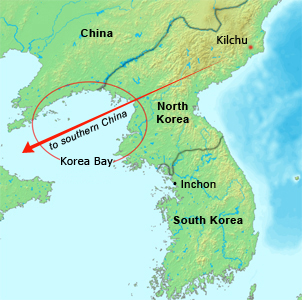
This would seem to indicate that the nuclear test suites prepared by North Korea are “shaped” (the North Koreans are very good at digging) in order to avoid detection. The mountainous terrain and soil conditions around the site (near Kilchu) may also help to dampen vibrations.

One reason that such good measurements could be collected to the southwest is due to the shape of Korea Bay, on the Yellow Sea, which acts like a type of seismic echo chamber for the upper Korean peninsula – similar to the way that your voice is projected when you speak into the small, open end of a hollow cone.

302px-location_of_west_korea_bay2

Okay, so now you know.

But, what can we do about it?

To start, maybe we should take a penetratingly good look at every country that is known to have dealt with A.Q. Khan’s network – and pay special attention to the ones who are working aggressively on long-range missile programs. That second group (a very ‘exclusive’ club) appears to have only two members: North Korea and Iran.

Of course, there’s also Pakistan, but that’s a whole other predicament.

(Update: For info on the May 25, 2009 test window click here.)

8 Comments

Filed under Chicanery, Conflict, Images

Our False Sense of CyberSecurity

This week, we learned about a wave of successful on-line hacks of the US electrical grid. We also heard about a fast-evolving virus (Conficker C) that has been actively organising millions of infected/enslaved PCs worldwide into a very formidable (and potentially malevolent) Botnet.

On-line insecurity is nothing new, but it always represents a risk.

Some people might give these stories a second thought, but their third thought would probably be, “Nah, [insert name of responsible organisation here] will take care of it.”

We have long relied upon groups like Microsoft, Symantec and “the government” to shield us from the not-so-nice elements of network computing, but is it reasonable to assume that they will always be successful in defending us?

On September 11, 2001, many millions of Americans (and, globally, many hundreds of millions more) followed in horror and disbelief the events of that tragic day. The tools of destruction appeared to be nothing more than box cutters, duct tape, some flight training and, of course, four passenger jets laden with aviation fuel. Twenty-or-so fervent radicals (and their controllers) had succeeded in turning these mundane emblems of Western society into deadly weapons of massive destruction.

No one seemed to spend much time openly investigating whether compromises in digital infrastructure contributed directly or indirectly to the terrible outcome, but there are several clues which point to the possibility that this may be true:

The GPS Downgrade

On September 12th, GPS (global positioning system) resolution for unlicensed commercial and consumer use was reduced from 10 metres to 100 metres, even though there had been no formal acknowledgment that GPS had been used by the hijackers to guide the planes to their fatal destinies. In fact, the guidance gear aboard the aircraft would have been far superior to that which could be bought at the retail level by the attackers. This could be viewed as strictly a precautionary manoeuvre by the government, because there was no way of knowing whether further attacks were forthcoming, or it could have been based on a suspicion that the aircraft may have been guided to their targets by complicated auto-pilot reprogramming in the cockpit — or even remote control. Each of the targeted planes carried on-board remote guidance and control systems designed to permit air traffic control (ATC) to assume command in the event of pilot incapacitation.

(I heard the report of the GPS downgrade during a newscast by CFRB 1010AM on September 12th and verified the information on-line the next day but can find no links to those stories today. Sorry, you’ll have to do your own digging on that one.)

One of the hijackers (Ziad Jarrah) attempted to purchase four handheld GPS units from a flight store on August 22, 2001, but was only able to purchase one, along with some aeronautical charts. Zacarias Moussawi (the so-called “20th hijacker” who did not make it onto his flight or was for some other reason not included in the operation) tried to purchase some GPS equipment, asking whether it could be used for aeronautics. I don’t know if any GPS units were taken aboard any of the four flights; that didn’t appear to be covered in the official 9/11 Report. (PDF – 7.2 MB)

Slacker Flight Students

By some accounts, the hijackers who took their pre-attack flight training in the United States were poor students. However, they wouldn’t need to be very well-trained if all they had to do was to keep the flight crew from disengaging the auto-pilot. (The remote guidance systems installed in the planes required that the auto-pilot be engaged in order for remote control to be established.) Flying a large jet at high speed and low altitude takes a very good pilot with top-notch training. This is especially true in the case of the Pentagon strike because of the building’s relatively low physical profile.

“He [Hani Hanjour] was a pain in the rear. We didn’t want him back at our school because he was not serious about becoming a good pilot.”

— Duncan Hastie, Owner, CRM Airline Training Center in Scottsdale, Ariz.

Despite failing his flight certification and being graded unfavourably by several flight instructors, Hanjour is thought to have been at the controls of the flight that slammed into the Pentagon on September 11th — an assault requiring a high degree of skill.

One Year Later

Just over a year after the 9-11 attacks, the terror of random shootings gripped the Beltway. The first fatality in the area was James Martin, an employee of the National Oceanic and Atmospheric Administration (NOAA). In June, 2002, Mr. Martin cleaned, wiped and delivered ten retired NOAA computers to a school (PDF – pg.4) as part of a giving program that he personally championed.

(Note: NOAA’s network is directly linked to the US Air Traffic Control network because of the need for accurate and immediate weather reports.)

We may never know whether Mr. Martin found some evidence of unauthorised access in those federal machines, but if he had, he probably would have reported it to the FBI. Any such reports would be forwarded to the National Infrastructure Protection Center (NIPC) and would certainly have come across the desk of the NIPC-FBI liaison at the fledgling InfraGard program.

InfraGard is an information sharing and analysis effort serving the interests and combining the knowledge base of a wide range of members. At its most basic level, InfraGard is a partnership between the Federal Bureau of Investigation and the private sector. InfraGard is an association of businesses, academic institutions, state and local law enforcement agencies, and other participants dedicated to sharing information and intelligence to prevent hostile acts against the United States. InfraGard Chapters are geographically linked with FBI Field Office territories.

from the InfraGard website

Although the InfraGard program has since been expanded to include physical threats, it was primarily concerned in 2001 with the identification and containment of cyber threats to key digital infrastructure systems, including: electrical grids, water provision and treatment facilities, nuclear installations and commercial aviation systems.

The FBI analyst leading the program was Linda Franklin, who (like Martin) also happened to be killed by the Beltway Snipers. Ms. Franklin, shot down in front of her husband in the parking lot of a Home Depot in Fairfax, Virginia, was the driving force behind the InfraGard program, though her relative importance (with respect to cyber-security) was played down in most media reports. InfraGard established the Linda Franklin National Achievement Award in 2003.

InfraGard Franklin Award

Rest in peace, Linda, James, et al.

The ’Net Result

Technologically advanced societies rely heavily on the technology they create.

That’s both a strength and a weakness; a double-edged sword.

Is it possible to live by it without dying by it?

© 2009

18 Comments

Filed under Chicanery, Conflict, Economy, Reason