Category Archives: Science

It’s an Official Pandemic

WHO declares first 21st century flu pandemic

By Stephanie Nebehay

Photo: CDC Influenza Laboratory

Photo: CDC Influenza Laboratory

GENEVA (Reuters) – The World Health Organization declared the first flu pandemic of the 21st century on Thursday, Sweden’s health ministry said.

The health ministry said the United Nations agency was raising its pandemic flu alert to the top phase 6 on a six-point scale, indicating the first influenza pandemic since 1968 is under way.

“Today… the Minister for Elderly Care and Public Health Maria Larsson has called a press conference following a decision by the WHO to raise the pandemic level to six for the influenza A H1N1 virus,” the ministry said in a statement.

Continue reading

Background on recent pandemic scares (avian flu, SARS).

2 Comments

Filed under Life, Science

What is Gravity made of ?

I saw an interesting question on the Big Question blog tonight:

Q: What is gravity made out of?

A: Gravity is made of mass. No mass. No gravity.

Mass has a natural affinity for mass. The attraction works in much
the same way that tiny bubbles in a liquid (the medium) tend to merge
into larger bubbles — with the difference being that the medium of
gravity is the vacuum that exists in both the atomic centre and in all
intervening distances between elemental masses, which, to an atom,
are indistinguishable from the vacuum of space. The concentric layers
of the atomic structure maintain a state of separation between the
internal and external vacuums creating an interactive ‘anti-medium’
which facilitates and exposes the observed ‘attractive’ mass effect.

In a somewhat wry, McLuhan-esque way: The medium is the massage.
.
For more on gravity
.

9 Comments

Filed under Reason, Science

Why the LHC won’t help us find the “god particle”

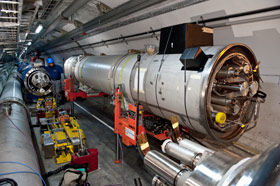
pr_06The Large Hadron Collider (LHC) at CERN near Geneva, Switzerland, was designed to create the same sort of high energy conditions that were present during the so-called “Big Bang”. Among the mysteries that Team LHC hopes to unravel: Revealing the nature of the theoretical substances known as “Dark Energy” and  “Dark Matter”; confirming the existence of the Higgs Boson (or “god particle”) as predicted by the Standard Model of quantum mechanics; and determining which, if any, of the current Grand Unification Theories is correct.

With respect to the Higgs Boson (the quantum particle thought to be responsible for giving atoms their mass) as well as with much respect to Dr. Higgs, I have a problem with the concept of a quantum “god particle”. My objection has little to do with the sacrilege of the name (offered by Leon Lederman in his 1993 popular science book), but rather the notion that one particular subatomic component can be responsible for all the mass of the unity to which it belongs.

There are two absolute states of unity in the universe: the atom (chiefly represented by hydrogen) which will endure indefinitely if sequestered from the transformative traumas of fission and fusion; and the universe itself (which has reportedly been around for a very, very long time). In between these absolutes exist myriad aggregations of matter displaying varying degrees of unity, mass, homogeneity and permanence: from planets, comets, stars and galaxies, to the seeming singularity of “black holes” — but each of these is simply echoic of our atomic and universal archetypes.

From everything I’ve read (never having had the pleasure of meeting the man) Peter Higgs seems to be a learned, conscientious physicist and a bona fide gentleman. This does not, however, vaccinate him against ever having a bad idea.

So, it has to be said:   The mass of the atom comes from the functional structure of the atom itself, not from a theoretical subatomic particle. Simply put, the atom is the “god particle” — and so is the Universe.


Keep up to date on LHC activities at CERN.

.

10 Comments

Filed under Reason, Science

Hello? This is Us.

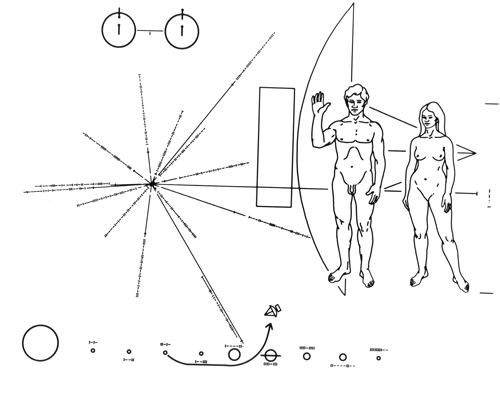
Below is the image featured on a plaque installed on both the Pioneer 10 and Pioneer 11 space probes launched in 1972 and 1973, respectively. It is intended to be our introduction to other intelligent life in the galaxy — should it eventually be found by some deep space traveler or interstellar trash collector.
GPN-2000-001623-500pxSome have questioned the wisdom of sending this kind of information into space; explaining how to get to where we are; how we think; and how nice ’n’ juicy we look.

Realistically, though, this is much less of a concern than the programming we’ve been blasting out into the universe for years now. The aliens, if any, in the 70 Virginus star system (58 light years out) could be watching I love Lucy right now — but, unlike us, they wouldn’t have to watch it in re-runs!

An explanation of the plaque by NASA:

“The Pioneer F spacecraft, destined to be the first human made object to escape from the solar system into interstellar space, carries this pictorial plaque. It is designed to show scientifically educated inhabitants of some other star system, who might intercept it millions of years from now, when Pioneer was launched, from where, and by what kind of beings (With the hope that they would not invade Earth). The design is etched into a 6 inch by 9 inch gold-anodized aluminum plate, attached to the spacecraft’s attenna support struts in a position to help shield it from erosion by interstellar dust. The radiating lines at left represents the positions of 14 pulsars, a cosmic source of radio energy, arranged to indicate our sun as the home star of our civilization. The “1-” symbols at the ends of the lines are binary numbers that represent the frequencies of these pulsars at the time of launch of Pioneer F relative of that to the hydrogen atom shown at the upper left with a “1” unity symbol. The hydrogen atom is thus used as a “universal clock,” and the regular decrease in the frequencies of the pulsars will enable another civilization to determine the time that has elapsed since Pioneer F was launched. The hydrogen is also used as a “universal yardstick” for sizing the human figures and outline of the spacecraft shown on the right. The hydrogen wavelength, about 8 inches, multiplied by the binary number representing “8” shown next to the woman gives her height, 64 inches. The figures represent the type of creature that created Pioneer. The man’s hand is raised in a gesture of good will. Across the bottom are the planets, ranging outward from the Sun, with the spacecraft trajectory arching away from Earth, passing Mars, and swinging by Jupiter.” Source: http://grin.hq.nasa.gov/ABSTRACTS/GPN-2000-001623.html

Another interesting about the Pioneer missions is that the craft have unexpectedly started slowing down.
More on that later…


2 Comments

Filed under Humour, Life, Reason, Science

Home Grown

Have you ever traveled to a faraway place only to run into a friend or neighbour in a café or train station? So, what do people almost invariably say to each other when they encounter this spooky coincidence?

“My goodness, it’s a small world.”

“Yes, it certainly is,” comes the response.

Inventions like radio, the telephone, jet travel and the Internet have all teamed up with coincidence to make the Earth seem even smaller, but I think we all know that our planet isn’t actually shrinking. On the other hand, though, it could very well be trending in the opposite direction.

If you haven’t done so already, you should have a look at Neal Adams’ 2005 animation of the expansion of Earth over hundreds of millions of years. 


More on this important topic later…

Leave a comment

Filed under Science, Video