Stratfor: Ukraine Turns From Revolution to Recovery

By George Friedman
Stratfor Global Intelligence

The uprising in Kiev has apparently reached its conclusion. President Viktor Yanukovich and the opposition reached an agreement, negotiated by the Polish, German and French foreign ministers. The parliament is now effectively in charge, deciding who will be ministers and when elections will be held, whether to dismiss judges and so on. It isn’t clear whether the parliament can fire the sitting president without impeachment and trial, but all of this is now moot. What is interesting is that the Polish, French and German foreign ministers negotiated an outcome that, for practical purposes, ignored the Constitution of Ukraine. It sets an interesting precedent. But for Ukraine, the constitution didn’t have the patina of tradition that a true constitution requires, and few will miss Yanukovich.

The question now is whether all of this makes any real difference in Ukraine or the world. There is a new temporary leadership, although it is still factionalized and the leaders of the factions have not fully emerged. The effect of hostile gunfire will forge unity in Kiev for a while, but in due course, ideology, ambition and animosity will re-emerge. That will make governing Ukraine as difficult as in the past, particularly because the differences among the neo-Nazis, the liberals and groups in between — all of which manned the barricades — are profound. A government of national unity will be difficult to form.

Another issue is what will happen the next time crowds storm government buildings. The precedent has been set — or rather, it was set during the 2004 Orange Revolution — that governments and regimes can be changed by a legalistic sleight of hand. At some point a large crowd will gather and occupy buildings. If the government opens fire, it is run by monsters. I don’t mean that ironically; I mean it literally. But if the government allows itself to be paralyzed by demonstrators, then how can it carry out its constitutional responsibilities? I don’t mean that ironically either. The Ukrainian Constitution, new or old, is meaningless because Ukrainians will not endure the pain of following it — and because foreign powers will pressure them to deviate from constitutional democracy in order to create a new one.

There should be no mistake. The Yanukovich government was rotten to the core, and he will not be missed. But most governments of Ukraine will be rotten to the core, partly because there is no tradition of respect for the law and because of the way property was privatized. How could there be a tradition of law in a country that was reduced to a province of another state and that numbered among its rulers Josef Stalin? Privatization, following the fall of the Soviet Union, occurred suddenly with vague rules that gave the advantage to the fast and ruthless. These people now own Ukraine, and however much the crowd despises them, it can’t unseat them. The oligarchs, as rich people in the former Soviet Union are called, are free; they can eliminate their critics or bribe them into silence. The only thing that is more powerful than money is a gun. But guns cost money and lives.

The idea that what will follow the Ukrainian revolution will be the birth of a liberal democracy reminds me of the Arab Spring. In the West, there is a tradition of seeing a passionate crowd massed in a square as the voice of the people. Reporters interview demonstrators and hear that they want an end to a corrupt and evil regime and subliminally recall the storming of the Bastille, the founding myth of the revolutionary tradition. A large crowd and a building anger at government evil points to the millennium.

In the Arab Spring the hope was great and the results disappointing. There was genuine hope for change, and observers assumed that the change was for liberal democracy. Perhaps it will yet be. Sometimes it was a change to a very different type of regime. What is portrayed and seen in this situation are the corrupt leaders commanding brutal soldiers. If the regime and the soldiers are wicked, it follows by this storyboard logic of good and evil that then their victims must be virtuous. It is rarely that easy. It is not only that the crowd is usually divided into many factions and bound together only by anger at the regime and the passionate moment. It is also that unexpected consequences lead them far from what they intended.

How Long Will Unity Last?

The deepest symbolism of revolution, and the most problematic, is that the people in the square speak for the people as a whole. The assumption made by the three foreign ministers was that in the negotiation between the three leaders of the demonstrators and the president, the protests’ leaders were more faithful representatives of the people than the elected president. They may have been in this case, but it is not certain.

Parts of Ukraine are bitterly angry about the outcome in Kiev. A Russian flag was raised over the city hall of Sevastopol, located in Crimea in the south, over the weekend. Crimea has historically belonged to Russia. In 1954, Nikita Khrushchev took it away from Russia and gave it to Ukraine. The Russians in Crimea have never really liked being part of Ukraine and the demonstrators didn’t represent them. Nor did they represent all those who live in the eastern part of the country, where Russian is commonly spoken and where being close to Russia is both an economic and cultural desire.

Thus there are two questions. The first is whether there is enough unity in the Ukrainian parliament to do what they must now do: create a government. The excitement of the moment has hidden the factions, which will soon re-emerge along with new ones. Yanukovich was not without support, for good reasons or bad. His supporters are bitter at this outcome and they are biding their time. In addition, the oligarchs are weaving their webs, save that many of the lawmakers are already caught in their web, some happily and some not. The underlying constraints that created the Yanukovich government are still there and can create a new Yanukovich out of the most enlightened Ukrainian leader.

The second question is whether Ukraine can remain united. The distinctions between the region oriented toward the West and that oriented toward Russia have been there from the beginning. In the past, governments have tried to balance between these two camps. Our three foreign ministers and the leaders of the demonstration have signaled that the days of taking Crimea and the east into account are over. At the very least their interests weren’t represented at the talks. Those interests could be rebalanced in the parliament, or they could be dismissed. If the latter were to happen, will Ukraine split in two? And if it does, what will be the economic and social consequences? If parliament takes to accommodating the two sides and their respective oligarchs, then how does it avoid winding up with a more photogenic and sympathetic Yanukovich?

The Motives of Outsiders

What happened to Ukraine mattered deeply to the Germans, French, Poles and Americans, all of whom had a deep involvement and sympathy for the demonstrators and hostility toward Yanukovich. Certainly it matters to the Russians, for whom maintaining at least a neutral Ukraine is essential to the national interest. This entire crisis began when Yanukovich decided to reject closer ties to the European Union. It was that decision that triggered the demonstrations, which, after violent repression, evolved from desiring closer EU ties to desiring regime change and blood.

The Ukrainian government has $13 billion in debt, owed mostly to Western institutions. The Russian government has agreed to provide Ukraine with $15 billion in aid doled out in tranches to cover it, since Ukraine can’t. Russia is now withholding additional aid until it can be confident the emerging government in Kiev is one with which it can work. It has also given Ukraine discounted natural gas. Without this assistance Ukraine would be in an even worse situation.

In turning toward Europe, parliament has to address refinancing its debt and ensure that the Russians will continue to discount natural gas. The Europeans are in no position politically to underwrite the Ukrainian debt. Given the economic situation and austerity in many EU countries, there would be an uproar if Brussels diverted scarce resources to a non-member. And regardless of what might be believed, the idea that Ukraine will become a member of the European Union under current circumstances is dismal. The bloc has enough sick economies on its hands.

The Germans have suggested that the International Monetary Fund handle Ukraine’s economic problem. The IMF’s approach to such problems is best compared to surgery without anesthesia. The patient may survive and be better for it, but the agony will be intense. In return for any bailout, the IMF will demand a restructuring of Ukraine’s finances. Given Ukraine’s finances, that restructuring would be dramatic. And the consequences could well lead to yet another round of protests.

The Russians have agreed to this, likely chuckling. Either parliament will reject the IMF plan and ask Russia to assume the burden immediately, or it will turn to Russia after experiencing the pain. There is a reason the Russians have been so relaxed about events in Ukraine. They understand that between the debt, natural gas and tariffs on Ukrainian exports to Russia, Ukraine has extremely powerful constraints. Under the worst circumstances Ukraine would move into the Western camp an economic cripple. Under the best, Ukraine would recognize its fate and turn to Russia.

What the Europeans and Americans were doing in Ukraine is less clear. They had the triumphant moment and they have eliminated a corrupt leader. But they certainly are not ready to take on the burden of Ukraine’s economic problems. And with those economic problems, the ability to form a government that does not suffer from the ills of Yanukovich is slim. Good intentions notwithstanding, the Ukrainians will not like the IMF deal.

I will guess at two motives for European and American actions. One is to repay the Russians for their more aggressive stance in the world and to remind them of how vulnerable Russia is. The second is as a low-risk human rights intervention to satisfy internal political demand without risking much. The pure geopolitical explanation — that they did this in order to gain a platform from which to threaten Russia and increase its caution — is hard to believe. None of these powers were in a position to protect Ukraine from Russian economic or military retaliation. None of them have any appetite for threatening Russia’s fundamental interests.

As stated above, the question now is two fold. Will the Ukrainian parliament, once the adrenaline of revolution stops flowing, be able to govern, or will it fall into the factional gridlock that a presidential system was supposed to solve? Further, will the east and Crimea decide they don’t want to cast their lot with the new regime and proceed to secede, either becoming independent or joining Russia? In large part the second question will be determined by the first. If the parliament is gridlocked, or it adopts measures hostile to the east and Crimea, secession is possible. Of course, if it decides to accommodate these regions, it is not clear how the government will differ from Yanukovich’s.

Revolutions are much easier to make than to recover from. This was not such a vast uprising that it takes much recovery. But to the extent that Ukraine had a constitutional democracy, that is now broken by people who said their intention was to create one. The issue is whether good intentions align with reality. It is never a bad idea to be pessimistic about Ukraine. Perhaps this time will be different.
 
 
Ukraine Turns From Revolution to Recovery is republished with permission of Stratfor.”


Leave a comment

Filed under Conflict, Peace, Reason

i almost saw the web

i’ve seen it grow from being a concern of almost no one, to being indispensable to almost everyone; and having heard of souls to whom it has become almost everything, i wonder how different they could really be from almost anyone, and what this world might look like if the web eventually learns to become everything to everyone — a scenario that seems more plausible today than it did back then

Leave a comment

Filed under Life, Words

Stratfor: The Geopolitics of the Syrian Civil War

By Reva Bhalla
Stratfor Global Intelligence

International diplomats will gather Jan. 22 in the Swiss town of Montreux to hammer out a settlement designed to end Syria’s three-year civil war. The conference, however, will be far removed from the reality on the Syrian battleground. Only days before the conference was scheduled to begin, a controversy threatened to engulf the proceedings after the United Nations invited Iran to participate, and Syrian rebel representatives successfully pushed for the offer to be rescinded. The inability to agree upon even who would be attending the negotiations is an inauspicious sign for a diplomatic effort that was never likely to prove very fruitful.

There are good reasons for deep skepticism. As Syrian President Bashar al Assad’s forces continue their fight to recover ground against the increasingly fratricidal rebel forces, there is little incentive for the regime, heavily backed by Iran and Russia, to concede power to its sectarian rivals at the behest of Washington, especially when the United States is already negotiating with Iran. Ali Haidar, an old classmate of al Assad’s from ophthalmology school and a long-standing member of Syria’s loyal opposition, now serving somewhat fittingly as Syria’s National Reconciliation Minister, captured the mood of the days leading up to the conference in saying “Don’t expect anything from Geneva II. Neither Geneva II, not Geneva III nor Geneva X will solve the Syrian crisis. The solution has begun and will continue through the military triumph of the state.”

Widespread pessimism over a functional power-sharing agreement to end the fighting has led to dramatic speculation that Syria is doomed either to break into sectarian statelets or, as Haidar articulated, revert to the status quo, with the Alawites regaining full control and the Sunnis forced back into submission. Both scenarios are flawed. Just as international mediators will fail to produce a power-sharing agreement at this stage of the crisis, and just as Syria’s ruling Alawite minority will face extraordinary difficulty in gluing the state back together, there is also no easy way to carve up Syria along sectarian lines. A closer inspection of the land reveals why.

The Geopolitics of Syria

Before the 1916 Sykes-Picot agreement traced out an awkward assortment of nation-states in the Middle East, the name Syria was used by merchants, politicians and warriors alike to describe a stretch of land enclosed by the Taurus Mountains to the north, the Mediterranean to the west, the Sinai Peninsula to the south and the desert to the east. If you were sitting in 18th-century Paris contemplating the abundance of cotton and spices on the other side of the Mediterranean, you would know this region as the Levant — its Latin root “levare” meaning “to raise,” from where the sun would rise in the east. If you were an Arab merchant traveling the ancient caravan routes northward from the Hejaz, or modern-day Saudi Arabia, you would have referred to this territory in Arabic as Bilad al-Sham, or the “land to the left” of Islam’s holy sites on the Arabian Peninsula.

Whether viewed from the east or the west, the north or the south, Syria will always find itself in an unfortunate position surrounded by much stronger powers. The rich, fertile lands straddling Asia Minor and Europe around the Sea of Marmara to the north, the Nile River Valley to the south and the land nestled between the Tigris and the Euphrates rivers to the east give rise to larger and more cohesive populations. When a power in control of these lands went roaming for riches farther afield, they inevitably came through Syria, where blood was spilled, races were intermixed, religions were negotiated and goods were traded at a frenzied and violent pace.

Consequently, only twice in Syria’s pre-modern history could this region claim to be a sovereign and independent state: during the Hellenistic Seleucid dynasty, based out of Antioch (the city of Antakya in modern-day Turkey) from 301 to 141 B.C., and during the Umayyad Caliphate, based out of Damascus, from A.D. 661 to 749. Syria was often divided or subsumed by its neighbors, too weak, internally fragmented and geographically vulnerable to stand its own ground. Such is the fate of a borderland.

Unlike the Nile Valley, Syria’s geography lacks a strong, natural binding element to overcome its internal fissures. An aspiring Syrian state not only needs a coastline to participate in sea trade and guard against sea powers, but also a cohesive hinterland to provide food and security. Syria’s rugged geography and patchwork of minority sects have generally been a major hindrance to this imperative.

Syria’s long and extremely narrow coastline abruptly transforms into a chain of mountains and plateaus. Throughout this western belt, pockets of minorities, including Alawites, Christians and Druze, have sequestered themselves, equally distrustful of outsiders from the west as they are of local rulers to the east, but ready to collaborate with whomever is most likely to guarantee their survival. The long mountain barrier then descends into broad plains along the Orontes River Valley and the Bekaa Valley before rising sharply once again along the Anti-Lebanon range, the Hawran plateau and the Jabal al-Druze mountains, providing more rugged terrain for persecuted sects to hunker down and arm themselves.

Just west of the Anti-Lebanon mountains, the Barada river flows eastward, giving rise to a desert oasis also known as Damascus. Protected from the coast by two mountain chains and long stretches of desert to the east, Damascus is essentially a fortress city and a logical place to make the capital. But for this fortress to be a capital worthy of regional respect, it needs a corridor running westward across the mountains to Mediterranean ports along the ancient Phoenician (or modern-day Lebanese) coast, as well as a northward route across the semi-arid steppes, through Homs, Hama and Idlib, to Aleppo.

The saddle of land from Damascus to the north is relatively fluid territory, making it an easier place for a homogenous population to coalesce than the rugged and often recalcitrant coastline. Aleppo sits alongside the mouth of the Fertile Crescent, a natural trade corridor between Anatolia to the north, the Mediterranean (via the Homs Gap) to the west and Damascus to the south. While Aleppo has historically been vulnerable to dominant Anatolian powers and can use its relative distance to rebel against Damascus from time to time, it remains a vital economic hub for any Damascene power.

Finally, jutting east from the Damascus core lie vast stretches of desert, forming a wasteland between Syria and Mesopotamia. This sparsely populated route has long been traveled by small, nomadic bands of men — from caravan traders to Bedouin tribesmen to contemporary jihadists — with few attachments and big ambitions.

Demography by Design

The demographics of this land have fluctuated greatly, depending on the prevailing power of the time. Christians, mostly Eastern Orthodox, formed the majority in Byzantine Syria. The Muslim conquests that followed led to a more diverse blend of religious sects, including a substantial Shiite population. Over time, a series of Sunni dynasties emanating from Mesopotamia, the Nile Valley and Asia Minor made Syria the Sunni-majority region that it is today. While Sunnis came to heavily populate the Arabian Desert and the saddle of land stretching from Damascus to Aleppo, the more protective coastal mountains were meanwhile peppered with a mosaic of minorities. The typically cult-like minorities forged fickle alliances and were always on the lookout for a more distant sea power they could align with to balance against the dominant Sunni forces of the hinterland.

The French, who had the strongest colonial links to the Levant, were masters of the minority manipulation strategy, but that approach also came with severe consequences that endure to this day. In Lebanon, the French favored Maronite Christians, who came to dominate Mediterranean sea trade out of bustling port cities such as Beirut at the expense of poorer Sunni Damascene merchants. France also plucked out a group known as the Nusayris living along the rugged Syrian coast, rebranded them as Alawites to give them religious credibility and stacked them in the Syrian military during the French mandate.

When the French mandate ended in 1943, the ingredients were already in place for major demographic and sectarian upheaval, culminating in the bloodless coup by Hafiz al Assad in 1970 that began the highly irregular Alawite reign over Syria. With the sectarian balance now tilting toward Iran and its sectarian allies, France’s current policy of supporting the Sunnis alongside Saudi Arabia against the mostly Alawite regime that the French helped create has a tinge of irony to it, but it fits within a classic balance-of-power mentality toward the region.

Setting Realistic Expectations

The delegates discussing Syria this week in Switzerland face a series of irreconcilable truths that stem from the geopolitics that have governed this land since antiquity.

The anomaly of a powerful Alawite minority ruling Syria is unlikely to be reversed anytime soon. Alawite forces are holding their ground in Damascus and steadily regaining territory in the suburbs. Lebanese militant group Hezbollah is meanwhile following its sectarian imperative to ensure the Alawites hold onto power by defending the traditional route from Damascus through the Bekaa Valley to the Lebanese coast, as well as the route through the Orontes River Valley to the Alawite Syrian coast. So long as the Alawites can hold Damascus, there is no chance of them sacrificing the economic heartland.

It is thus little wonder that Syrian forces loyal to al Assad have been on a northward offensive to retake control of Aleppo. Realizing the limits to their own military offensive, the regime will manipulate Western appeals for localized cease-fires, using a respite in the fighting to conserve its resources and make the delivery of food supplies to Aleppo contingent on rebel cooperation with the regime. In the far north and east, Kurdish forces are meanwhile busy trying to carve out their own autonomous zone against mounting constraints, but the Alawite regime is quite comfortable knowing that Kurdish separatism is more of a threat to Turkey than it is to Damascus at this point.

The fate of Lebanon and Syria remain deeply intertwined. In the mid-19th century, a bloody civil war between Druze and Maronites in the densely populated coastal mountains rapidly spread from Mount Lebanon to Damascus. This time around, the current is flowing in reverse, with the civil war in Syria now flooding Lebanon. As the Alawites continue to gain ground in Syria with aid from Iran and Hezbollah, a shadowy amalgam of Sunni jihadists backed by Saudi Arabia will become more active in Lebanon, leading to a steady stream of Sunni-Shiite attacks that will keep Mount Lebanon on edge.

The United States may be leading the ill-fated peace conference to reconstruct Syria, but it doesn’t really have any strong interests there. The depravity of the civil war itself compels the United States to show that it is doing something constructive, but Washington’s core interest for the region at the moment is to preserve and advance a negotiation with Iran. This goal sits at odds with a publicly stated U.S. goal to ensure al Assad is not part of a Syrian transition, and this point may well be one of many pieces in the developing bargain between Washington and Tehran. However, al Assad holds greater leverage so long as his main patron is in talks with the United States, the only sea power currently capable of projecting significant force in the eastern Mediterranean.

Egypt, the Nile Valley power to the south, is wholly ensnared in its own internal problems. So is Turkey, the main power to the north, which is now gripped in a public and vicious power struggle that leaves little room for Turkish adventurism in the Arab world. That leaves Saudi Arabia and Iran as the main regional powers able to directly manipulate the Syrian sectarian battleground. Iran, along with Russia, which shares an interest in preserving relations with the Alawites and thus its access to the Mediterranean, will hold the upper hand in this conflict, but the desert wasteland linking Syria to Mesopotamia is filled with bands of Sunni militants eager for Saudi backing to tie down their sectarian rivals.

And so the fighting will go on. Neither side of the sectarian divide is capable of overwhelming the other on the battlefield and both have regional backers that will fuel the fight. Iran will try to use its relative advantage to draw the Saudi royals into a negotiation, but a deeply unnerved Saudi Arabia will continue to resist as long as Sunni rebels still have enough fight in them to keep going. Fighters on the ground will regularly manipulate appeals for cease-fires spearheaded by largely disinterested outsiders, all while the war spreads deeper into Lebanon. The Syrian state will neither fragment and formalize into sectarian statelets nor reunify into a single nation under a political settlement imposed by a conference in Geneva. A mosaic of clan loyalties and the imperative to keep Damascus linked to its coastline and economic heartland — no matter what type of regime is in power in Syria — will hold this seething borderland together, however tenuously.
 
 
The Geopolitics of the Syrian Civil War is republished with permission of Stratfor.”


Leave a comment

Filed under Conflict, Reason

Comet ISON Passage

Solar activity spikes as Comet ISON approaches perihelion and continues as the comet’s remnant exits the NASA/ESA SOHO LASCO C3 viewing area. Solar volatility included some robust X-ray flares and coronal mass ejections, all of which serve to distinguish the comet’s perihelion window from the much calmer period that immediately precedes it.


Leave a comment

Filed under Science, Video

Axis of Empathy?

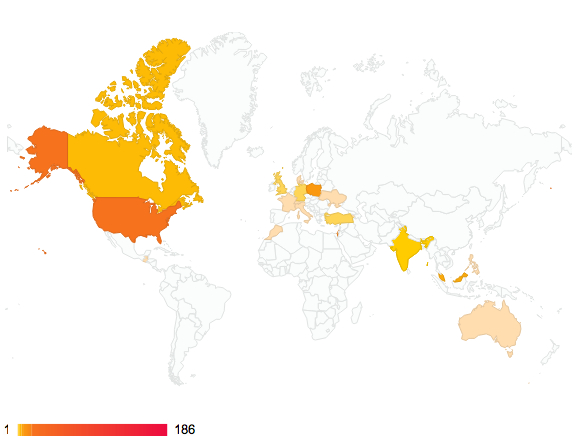
snAPoJi.7d.v2.map

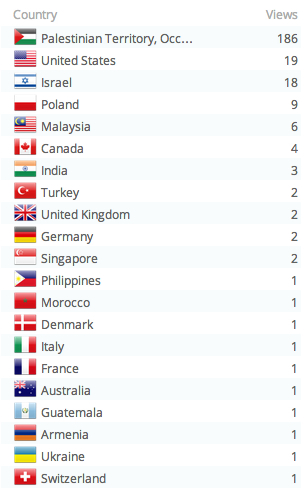
snAPoJi.7d.v2

APoJi
Snapshot of readers, by country
7 days, ending October 12, 2013

Leave a comment

Filed under Life, Reason