
in black holes
to neutrons bare
are atoms stripped;
ejected not 15 minutes
and already protons,
and soon…
upon any encounter,
hydrogen again
in black holes
to neutrons bare
are atoms stripped;
ejected not 15 minutes
and already protons,
and soon…
upon any encounter,
hydrogen again
APoJi
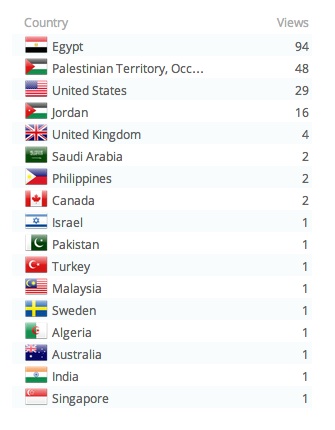
Snapshot of readers, by country
7 days, ending October 2, 2013
By George Friedman
Founder and Chairman
Stratfor Global Intelligence
Airstrikes by unmanned aerial vehicles have become a matter of serious dispute lately. The controversy focuses on the United States, which has the biggest fleet of these weapons and which employs them more frequently than any other country. On one side of this dispute are those who regard them simply as another weapon of war whose virtue is the precision with which they strike targets. On the other side are those who argue that in general, unmanned aerial vehicles are used to kill specific individuals, frequently civilians, thus denying the targeted individuals their basic right to some form of legal due process.
Let’s begin with the weapons systems, the MQ-1 Predator and the MQ-9 Reaper. The media call them drones, but they are actually remotely piloted aircraft. Rather than being in the cockpit, the pilot is at a ground station, receiving flight data and visual images from the aircraft and sending command signals back to it via a satellite data link. Numerous advanced systems and technologies work together to make this possible, but it is important to remember that most of these technologies have been around in some form for decades, and the U.S. government first integrated them in the 1990s. The Predator carries two Hellfire missiles — precision-guided munitions that, once locked onto the target by the pilot, guide themselves to the target with a high likelihood of striking it. The larger Reaper carries an even larger payload of ordnance — up to 14 Hellfire missiles or four Hellfire missiles and two 500-pound bombs. Most airstrikes from these aircraft use Hellfire missiles, which cause less collateral damage.
Unlike a manned aircraft, unmanned aerial vehicles can remain in the air for an extended period of time — an important capability for engaging targets that may only present a very narrow target window. This ability to loiter, and then strike quickly when a target presents itself, is what has made these weapons systems preferable to fixed wing aircraft and cruise missiles.
What makes unmanned aerial vehicle strikes controversial is that they are used to deliberately target specific individuals — in other words, people who are known or suspected, frequently by name, of being actively hostile to the United States or allied governments. This distinguishes unmanned aerial vehicles from most weapons that have been used since the age of explosives began. The modern battlefield — and the ancient as well — has been marked by anonymity. The enemy was not a distinct individual but an army, and the killing of soldiers in an enemy army did not carry with it any sense of personal culpability. In general, no individual soldier was selected for special attention, and his death was not an act of punishment. He was killed because of his membership in an army and not because of any specific action he might have carried out.
Another facet of the controversy is that it is often not clear whether the individuals targeted by these weapons are members of an enemy force. U.S. military or intelligence services reach that conclusion about a target based on intelligence that convinces them of the individual’s membership in a hostile group.
There are those who object to all war and all killing; we are not addressing those issues here. We are addressing the arguments of those who object to this particular sort of killing. The reasoning is that when you are targeting a particular individual based on his relationships, you are introducing the idea of culpability, and that that culpability makes the decision-maker — whoever he is — both judge and executioner, without due process. Those who argue this line also believe that the use of these weapons is a process that is not only given to error but also fundamentally violates principles of human rights and gives the state the power of life and death without oversight. Again excluding absolute pacifists from this discussion, the objection is that the use of unmanned aerial vehicles is not so much an act of war as an act of judgment and, as such, violates international law that requires due process for a soldier being judged and executed. To put it simply, the critics regard what they call drone strikes as summary executions, not acts of war.
The counterargument is that the United States is engaged in a unique sort of war. Al Qaeda and the allied groups and sympathetic individuals that comprise the international jihadist movement are global, dispersed and sparse. They are not a hierarchical military organization. Where conventional forces have divisions and battalions, the global jihadist movement consists primarily of individuals who at times group together into distinct regional franchises, small groups and cells, and frequently even these groups are scattered. Their mission is to survive and to carry out acts of violence designed to demoralize the enemy and increase their political influence among the populations they wish to control.
The primary unit is the individual, and the individuals — particularly the commanders — isolate themselves and make themselves as difficult to find as possible. Given their political intentions and resources, sparse forces dispersed without regard to national boundaries use their isolation as the equivalent of technological stealth to make them survivable and able to carefully mount military operations against the enemy at unpredictable times and in unpredictable ways.
The argument for using strikes from unmanned aerial vehicles is that it is not an attack on an individual any more than an artillery barrage that kills a hundred is an attack on each individual. Rather, the jihadist movement presents a unique case in which the individual jihadist is the military unit.
In war, the goal is to render the enemy incapable of resisting through the use of force. In all wars and all militaries, imperfect intelligence, carelessness and sometimes malice have caused military action to strike at innocent people. In World War II, not only did bombing raids designed to attack legitimate military targets kill civilians not engaged in activities supporting the military, mission planners knew that in some cases innocents would be killed. This is true in every military conflict and is accepted as one of the consequences of war.
The argument in favor of using unmanned aerial vehicle strikes is, therefore, that the act of killing the individual is a military necessity dictated by the enemy’s strategy and that it is carried out with the understanding that both intelligence and precision might fail, no matter how much care is taken. This means not only that civilians might be killed in a particular strike but also that the strike might hit the wrong target. The fact that a specific known individual is being targeted does not change the issue from a military matter to a judicial one.
It would seem to me that these strikes do not violate the rules of war and that they require no more legal overview than was given in thousands of bomber raids in World War II. And we should be cautious in invoking international law. The Hague Convention of 1907 states that:
The laws, rights, and duties of war apply not only to armies, but also to militia and volunteer corps fulfilling the following conditions:
To be commanded by a person responsible for his subordinates;
To have a fixed distinctive emblem recognizable at a distance;
To carry arms openly; and
To conduct their operations in accordance with the laws and customs of war.
The 1949 Geneva Convention states that:
Members of other militias and members of other volunteer corps, including those of organized resistance movements, belonging to a Party to the conflict and operating in or outside their own territory, even if this territory is occupied, provided that such militias or volunteer corps, including such organized resistance movements, fulfill the following conditions:
(a) that of being commanded by a person responsible for his subordinates;
(b) that of having a fixed distinctive sign recognizable at a distance;
(c) that of carrying arms openly;
(d) that of conducting their operations in accordance with the laws and customs of war.
Ignoring the question of whether jihadist operations are in accordance with the rules and customs of war, their failure to carry a “fixed distinctive sign recognizable at a distance” is a violation of both the Hague and Geneva conventions. This means that considerations given to soldiers under the rules of war do not apply to those waging war without insignia.
Open insignia is fundamental to the rules of war. It was instituted after the Franco-Prussian war, when French snipers dressed as civilians fired on Germans. It was viewed that the snipers had endangered civilians because it was a soldier’s right to defend himself and that since they were dressed as civilians, the French snipers — not the Germans — were responsible for the civilian deaths. It follows from this that, to the extent that jihadist militants provide no sign of who they are, they are responsible under international law when civilians are killed because of uncertainty as to who is a soldier and who is not. Thus the onus on ascertaining the nature of the target rests with the United States, but if there is error, the responsibility for that error rests with jihadists for not distinguishing themselves from civilians.
There is of course a greater complexity to this: attacking targets in countries that are not in a state of war with the United States and that have not consented to these attacks. For better or worse, the declaration of war has not been in fashion since World War II. But the jihadist movement has complicated this problem substantially. The jihadists’ strategy is to be dispersed. Part of its strategy is to move from areas where it is under military pressure to places that are more secure. Thus the al Qaeda core group moved its headquarters from Afghanistan to Pakistan. But in truth, jihadists operate wherever military and political advantages take them, from the Maghreb to Mumbai and beyond.
In a method of war where the individual is the prime unit and where lack of identification is a primary defensive method, the conduct of intelligence operations wherever the enemy might be, regardless of borders, follows. So do operations to destroy enemy units — individuals. If a country harbors such individuals knowingly, it is an enemy. If it is incapable of destroying the enemy units, it forfeits its right to claim sovereignty since part of sovereignty is a responsibility to prevent attacks on other countries.
If we simply follow the logic we laid out here, then the critics of unmanned aerial vehicle strikes have a weak case. It is not illegitimate to target individuals in a military force like the jihadist movement, and international law holds them responsible for collateral damage, not the United States. Moreover, respecting national sovereignty requires that a country’s sovereignty be used to halt attacks against countries with which they are not at war. When a country cannot or will not take those steps, and people within their border pose a threat to the United States, the country has no basis for objecting to intelligence operations and airstrikes. The question, of course, is where this ends. Yemen or Mali might be one case, but the logic here does not preclude any country. Indeed, since al Qaeda tried in the past to operate in the United States itself, and its operatives might be in the United States, it logically follows that the United States could use unmanned aerial vehicles domestically as well. Citizenship is likewise no protection from attacks against a force hostile to the United States.
But within the United States, or countries like the United Kingdom, there are many other preferable means to neutralize jihadist threats. When the police or internal security forces can arrest jihadists plotting attacks, there quite simply is no need for airstrikes from unmanned aerial vehicles. They are tools to be used when a government cannot or will not take action to mitigate the threat.
There are two points I have been driving toward. The first is that the outrage at targeted killing is not, in my view, justified on moral or legal grounds. The second is that in using these techniques, the United States is on a slippery slope because of the basis on which it has chosen to wage war.
The United States has engaged an enemy that is dispersed across the globe. If the strategy is to go wherever the enemy is, then the war is limitless. It is also endless. The power of the jihadist movement is that it is diffuse. It does not need vast armies to be successful. Therefore, the destruction of some of its units will always result in their replacement. Quality might decline for a while but eventually will recover.
The enemy strategy is to draw the United States into an extended conflict that validates its narrative that the United States is permanently at war with Islam. It wants to force the United States to engage in as many countries as possible. From the U.S. point of view, unmanned aerial vehicles are the perfect weapon because they can attack the jihadist command structure without risk to ground forces. From the jihadist point of view as well, unmanned aerial vehicles are the perfect weapon because their efficiency allows the jihadists to lure the United States into other countries and, with sufficient manipulation, can increase the number of innocents who are killed.
In this sort of war, the problem of killing innocents is practical. It undermines the strategic effort. The argument that it is illegal is dubious, and to my mind, so is the argument that it is immoral. The argument that it is ineffective in achieving U.S. strategic goals of eliminating the threat of terrorist actions by jihadists is my point.
Unmanned aerial vehicles provide a highly efficient way to destroy key enemy targets with very little risk to personnel. But they also allow the enemy to draw the United States into additional theaters of operation because the means is so efficient and low cost. However, in the jihadists’ estimate, the political cost to the United States is substantial. The broader the engagement, the greater the perception of U.S. hostility to Islam, the easier the recruitment until the jihadist forces reach a size that can’t be dealt with by isolated airstrikes.
In warfare, enemies will try to get you to strike at what they least mind losing. The case against strikes by unmanned aerial vehicles is not that they are ineffective against specific targets but that the targets are not as vital as the United States thinks. The United States believes that the destruction of the leadership is the most efficient way to destroy the threat of the jihadist movement. In fact it only mitigates the threat while new leadership emerges. The strength of the jihadist movement is that it is global, sparse and dispersed. It does not provide a target whose destruction weakens the movement. However, the jihadist movement’s weakness derives from its strength: It is limited in what it can do and where.
The problem of unmanned aerial vehicles is that they are so effective from the U.S. point of view that they have become the weapon of first resort. Thus, the United States is being drawn into operations in new areas with what appears to be little cost. In the long run, it is not clear that the cost is so little. A military strategy to defeat the jihadists is impossible. At its root, the real struggle against the jihadists is ideological, and that struggle simply cannot be won with Hellfire missiles. A strategy of mitigation using airstrikes is possible, but such a campaign must not become geographically limitless. Unmanned aerial vehicles lead to geographical limitlessness. That is their charm; that is their danger.
“Hellfire, Morality and Strategy is republished with permission of Stratfor.”
by Barry Rubin, GLORIA Center
Originally published Feb. 8, 2013
And if the good men are murdered by the forces of political evil then they certainly cannot do anything. Hence, the outcome is assured.
Thus, the “Arab Spring” has just been murdered with bullets and hijacked amid bloodstains. Here is the list of countries in the Middle East area currently ruled by Islamists: Egypt, the Gaza Strip, Iran, Lebanon, and Turkey. Syria will probably join them soon. Qatar has a pro-Islamist policy. Morocco technically has an Islamist government though the king neutralizes it in practice. Saudi Arabia is ruled by a strict Islamic regime but opposes the revolutionary Islamists though its money often spreads their doctrines elsewhere. Everyone is being forced into Sunni or Shia Islamist camps, backing radical forces in other countries so that their religious allegiance can conquer.
In this situation, only in Tunisia could the non-Islamists win fairly conducted elections. But an election isn’t fair if one side uses violence to ensure its victory and its ability to transform the country into a social-political dictatorship afterward.
I know that whenever I write an article on Tunisia it will have fewer readers than other topics. That’s understandable from the standpoint that Tunisia is a small country with little international impact and limited U.S. interests.
Yet Tunisia was the country where the “Arab Spring” began. And Tunisia is going to be the place where the Middle Eastern equivalent of the Spanish Civil War will be fought. In other words, it is the only place where moderate and “secularist” forces are going to fight and the only country where the moderates have a majority of the population — though not a majority of the guns — behind them.
Given that bellwether factor, they have just suffered a massive defeat which is simultaneously a major victory for the Islamist forces.
Briefly, what people who believe the Arabic-speaking world is heading toward democracy don’t understand is that they have helped unleash forces quite willing to engage in violence and that will not stop until they’ve achieve a total triumph. It’s sort of like Pandora who opened the box to unleash its spiritual whirlwinds and said, “This ought to be interesting!”
That’s why the assassination of Choukri Belaid is so important. He was leader of the Democratic Patriot party and a leader of the Popular Front opposition coalition. While the story will be obscure in the West it is devastating for Tunisia, the Arab liberals, and the future of the region. Belaid was the single most outspoken and determined anti-Islamist leader in the country, and indeed the most important openly anti-Islamist politician in the entire Arabic-speaking world. He wasn’t the only moderate politician in Tunisia but he was the main one who rejected Islamist rule and warned against Islamist intentions.
And how did the Islamist-dominated coalition react? The moment the leading opposition figure — the man around whom an anti-Islamist coalition might have been built following the next elections — was murdered it called for new elections.
Get it? The Brotherhood’s moderate coalition partners didn’t want elections now. And if you eliminate the tough moderate those remaining may be more pliable about caving in. It was quite conceivable that the non-Islamists would get a majority in the next elections–as they did in the previous one. But a majority divided among four parties isn’t enough. Last time, the moderate parties got 60 percent but their disunity allowed the largest single party, the Brotherhood, to take control of the government coalition with only 40 percent of the vote.
But a man like Belaid might have forged a moderate coalition government that would keep the Brotherhood out of power. In other words, though he led only the fourth largest party, Belaid was the key to forcing the Brotherhood out of power by convincing the four moderate parties to work together against the Islamist threat. His elimination isn’t just a crime, its a political strategy.
As I predicted a few days ago, destroying the left is going to be the Islamists’ priority and Tunisia is the only country where the political left poses a danger to them. Elsewhere it is too weak, confined to isolated individuals and publications.
Some decades ago, the killing of a left-wing leader by what Marxists would have called “clerical-fascist” forces would have provoked an outcry from the Western left. Nowadays, they don’t even blink — as we also saw in Iran — unless some misdeed can be blamed on the United States or Israel.
While Belaid stood firm, the two other main moderate parties were willing to try working with the Muslim Brotherhood, Belaid said “no” and warned — just as we have — that the Islamists were determined to create a dictatorship. He was the man to kill, an event which also has an intimidating effect on the other moderates. As Belaid’s brother put it: the killing was “a clear message to Tunisians… Shut up or we kill you.”
I don’t think the assassination was the result of a high-level conspiracy and especially not from the Brotherhood itself. Most likely, it was done by a small Salafist group.
But that’s the point. The Obama Administration views the Brotherhood as the bulwark against the Salafists. In fact, it is their big brother, often using the Salafists as shock troops to attack Western embassies, oppositionists, secularists, moderates, churches, and women who seek equality.
Ideally when the leader is going to be murdered the masses stand up and say, “I am Spartacus.” In reality, particularly in countries with anti-democratic political cultures, it doesn’t happen that way. Even if the four moderate parties do well in elections they still have to cooperate, having to face a wave of Salafist violence, too. Now if the Tunisian army were to stage a coup that would make a difference. But what do you think would happen if the generals went to the U.S. embassy and asked for America’s support to overthrow the Brotherhood? In Egypt, we do see a sort of uprising against the regime. But without the army’s support it doesn’t seem to have a chance of taking power. Still, one must keep an open mind and see what happens.
Few in the West will be aware that Belaid is the second moderate opposition leader killed in Tunisia during the last three months in Tunisia. During decades of Arab nationalist dictatorship Tunisia-style, murder was rarely employed.
The Islamists have no such inhibitions. They are the people to be afraid of. Consider that in Libya, the most obvious American client in the Arabic-speaking world, there’s no hint of arresting anyone for the murder of the U.S. ambassador and three American officials which happened five months ago! Don’t hold your breath.
A similar strategy to what has just happened in Tunisia took place in Lebanon a few years ago, where the Syrians and their Hizballah and other local allies murdered opposing parliamentarians, journalists, and judges until they came close enough to a legislative majority and to intimidating critics that they won the election and currently form the Lebanese government.
And what about Syria where Islamists are headed for power with America’s blessing? Or Washington where the main lobbyist for supporting the Brotherhood is becoming head of the CIA? And what about Egypt where dozens of demonstrators have been murdered by the Muslim Brotherhood regime as the West still proclaims that government’s democratic credentials, the international institutions negotiate the supply of billions of dollars and the United States sends advanced fighter planes and tanks as gifts?
The tide is only going in one direction and Obama’s policies are raising, not lowering, these sea levels.
By Robert D. Kaplan
Chief Geopolitical Analyst
Stratfor Global Intelligence
According to the elite newspapers and journals of opinion, the future of foreign affairs mainly rests on ideas: the moral impetus for humanitarian intervention, the various theories governing exchange rates and debt rebalancing necessary to fix Europe, the rise of cosmopolitanism alongside the stubborn vibrancy of nationalism in East Asia and so on. In other words, the world of the future can be engineered and defined based on doctoral theses. And to a certain extent this may be true. As the 20th century showed us, ideologies — whether communism, fascism or humanism — matter and matter greatly.
But there is another truth: The reality of large, impersonal forces like geography and the environment that also help to determine the future of human events. Africa has historically been poor largely because of few good natural harbors and few navigable rivers from the interior to the coast. Russia is paranoid because its land mass is exposed to invasion with few natural barriers. The Persian Gulf sheikhdoms are fabulously wealthy not because of ideas but because of large energy deposits underground. You get the point. Intellectuals concentrate on what they can change, but we are helpless to change much of what happens.
Enter shale, a sedimentary rock within which natural gas can be trapped. Shale gas constitutes a new source of extractable energy for the post-industrial world. Countries that have considerable shale deposits will be better placed in the 21st century competition between states, and those without such deposits will be worse off. Ideas will matter little in this regard.
Stratfor, as it happens, has studied the issue in depth. Herein is my own analysis, influenced in part by Stratfor’s research.
So let’s look at who has shale and how that may change geopolitics. For the future will be heavily influenced by what lies underground.
The United States, it turns out, has vast deposits of shale gas: in Texas, Louisiana, North Dakota, Pennsylvania, Ohio, New York and elsewhere. America, regardless of many of the political choices it makes, is poised to be an energy giant of the 21st century. In particular, the Gulf Coast, centered on Texas and Louisiana, has embarked upon a shale gas and tight oil boom. That development will make the Caribbean an economic focal point of the Western Hemisphere, encouraged further by the 2014 widening of the Panama Canal. At the same time, cooperation between Texas and adjacent Mexico will intensify, as Mexico increasingly becomes a market for shale gas, with its own exploited shale basins near its northern border.
This is, in part, troubling news for Russia. Russia is currently the energy giant of Europe, exporting natural gas westward in great quantities, providing Moscow with political leverage all over Central and particularly Eastern Europe. However, Russia’s reserves are often in parts of Siberia that are hard and expensive to exploit — though Russia’s extraction technology, once old, has been considerably modernized. And Russia for the moment may face relatively little competition in Europe. But what if in the future the United States were able to export shale gas to Europe at a competitive price?
The United States still has few capabilities to export shale gas to Europe. It would have to build new liquefaction facilities to do that; in other words, it would have to erect plants on the Gulf of Mexico that convert the gas into liquid so that it could be transported by ship across the Atlantic, where more liquefaction facilities there would reconvert it back into gas. This is doable with capital investment, expertise and favorable legislation. Countries that build such facilities will have more energy options, to export or import, whatever the case may be. So imagine a future in which the United States exports liquefied shale gas to Europe, reducing the dependence that European countries have on Russian energy. The geopolitics of Europe could shift somewhat. Natural gas might become less of a political tool for Russia and more of a purely economic one (though even such a not-so-subtle shift would require significant exports of shale gas from North America to Europe).
Less dependence on Russia would allow the vision of a truly independent, culturally vibrant Central and Eastern Europe to fully prosper — an ideal of the region’s intellectuals for centuries, even as ideas in this case would have little to do with it.
This might especially be relevant to Poland. For Poland may have significant deposits of shale gas. Were Polish shale deposits to prove the largest in Europe (a very big “if”), Poland could become more of an energy producer in its own right, turning this flat country with no natural defenses to the east and west — annihilated by both Germany and the Soviet Union in the 20th century — into a pivot state or midlevel power in the 21st. The United States, in turn, somewhat liberated from Middle East oil because of its own energy sources (including natural gas finds), could focus on building up Poland as a friendly power, even as it loses substantial interest in Saudi Arabia. To be sure, the immense deposits of oil and natural gas in the Arabian Peninsula, Iraq and Iran will keep the Middle East a major energy exporter for decades. But the shale gas revolution will complicate the world’s hydrocarbon supply and allocation, so that the Middle East may lose some of its primacy.
It turns out that Australia also has large new natural gas deposits that, with liquefaction facilities, could turn it into a principal energy exporter to East Asia, assuming Australia significantly lowers its cost of production (which may prove very hard to do). Because Australia is already starting to emerge as the most dependable military ally of the United States in the Anglosphere, the alliance of these two great energy producers of the future could further cement Western influence in Asia. The United States and Australia would divide up the world: after a fashion, of course. Indeed, if unconventional natural gas exploitation has anything to do with it, the so-called post-American world would be anything but.
The geopolitical emergence of Canada — again, the result of natural gas and oil — could amplify this trend. Canada has immense natural gas deposits in Alberta, which could possibly be transported by future pipelines to British Columbia, where, with liquefaction facilities, it could then be exported to East Asia. Meanwhile, eastern Canada could be the beneficiary of new shale gas deposits that reach across the border into the northeastern United States. Thus, new energy discoveries would bind the two North American countries closer, even as North America and Australia become more powerful on the world scene.
China also has significant deposits of shale gas in its interior provinces. Because Beijing is burdened by relatively few regulations, the regime could acquire the land and build the infrastructure necessary for its exploitation. This would ease somewhat China’s energy crunch and aid Beijing’s strategy to compensate for the decline of its coastal-oriented economic model by spurring development inland.
The countries that might conceivably suffer on account of a shale gas revolution would be landlocked, politically unstable oil producers such as Chad, Sudan and South Sudan, whose hydrocarbons could become relatively less valuable as these other energy sources come online. China, especially, might in the future lose interest in the energy deposits in such low-end, high-risk countries if shale gas became plentiful in its own interior.
In general, the coming of shale gas will magnify the importance of geography. Which countries have shale underground and which don’t will help determine power relationships. And because shale gas can be transported across oceans in liquid form, states with coastlines will have the advantage. The world will be smaller because of unconventional gas extraction technology, but that only increases the preciousness of geography, rather than decreases it.
“The Geopolitics of Shale is republished with permission of Stratfor.”

 imahd.ca