Category Archives: Chicanery

The Martyrdom of Mousavi

Iranian opposition leader and former presidential candidate Mir Hossein Mousavi has declared that he is prepared for martyrdom in his quest to reform the Iranian political system. Essentially, he has invited the government to slay him, knowing that this will only bolster his cause among the disenchanted  people of his country.

And yet, on the same day, another former presidential candidate, Mohsen Rezai, has delivered a letter to the Iranian government stating that Mr. Mousavi has changed his position and is now willing to work with the present government to effect change and that he no longer disputes the legitimacy of last year’s presidential elections. The letter welcomes Mousavi back to the fold and provides a veneer of plausible deniability for the government of Mahmoud Ahmadinejad in the event of Mousavi’s demise.

A major crackdown on dissent may be imminent.

Leave a comment

Filed under Chicanery, Conflict

Freedom Spotlight: IRAN

Here’s a quick look at how Iran is
doing on several key freedom indices:

Corruption Perceptions Index 2009 – Transparency International
The CPI ranks countries based on their level of perceived public-sector corruption.
Ranking: 168/180; 2008: 141/180; Change: (-27)

Index of Economic Freedom 2009 – Heritage Foundation
The study ranks countries based on trade, labour, business and investment freedoms as well as property rights, government size and freedom from corruption.
Ranking: 168/179; 2008: 151/179; Change: (-17)

Press Freedom Index 2009 – Reporters Without Borders
The index ranks countries based on the freedom extended to journalists operating there, whether domestic or foreign.
Ranking: 172/175; 2008: 166/175; Change: (-6)

Looking on the positive side, um… well…
at least they have the internet…
for now
and they can’t possibly drop six spots on next year’s Press Freedom Index!

The Scoop…
Iranians experience the same sort of lower-level graft and corruption that can be found in other states of the region.

More concerning, Iran offers its public limited visibility into the dealings (fiscal and otherwise) of its local, regional and national governments.

This same lack of transparency is also evident in its key industries, a growing number of which are being operated by high-ranking members or former members of its Islamic Revolutionary Guard Corps (IRGC).

The country’s media are variously mitigated in their coverage of internal and international events by self-censorship, government ownership or control, influence of the clergy, or even stern warnings from officials of the government or the Bassij — the multi-million member Islamic students paramilitary group often charged with local crowd control and dress code enforcement.

Foreign and domestic reporters have been arrested for investigating government activities and covering news events, most recently during the civil disobedience that followed the 2009 Presidential elections, the results of which many agree were pre-determined by the government itself.

The country’s main source of revenue comes from oil and gas exports, which are primarily nationalised. Most of the boon dollars from high oil prices in 2006-08 were ploughed into fruitless subsidies and a quickly expanding military complex.

Economic diversification is somewhat limited. Foreign investment is slow in coming due to international financial sanctions and concerns about Iran’s nuclear program. This provides fewer (and weaker) investment opportunities for Iranians (and others) to invest in Iranian businesses.

Unfortunately, they are also trending in the wrong direction on all indices.

~

More bad news: US State Department report on Religious Freedom in Iran.

Leave a comment

Filed under Chicanery, Conflict, Economy

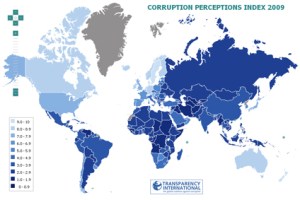
Corruption Index 2009

Transparency International, a global anti-corruption group, has released the results of its 2009 Corruption Perceptions Index (CPI) surveys of 180 countries.

Leading the list of most ‘trustable’ countries, with low perceived public-sector corruption, were: New Zealand, Denmark, Singapore, Sweden, Switzerland, Finland, Netherlands, Australia, Canada and Iceland.

At the very bottom of the pile: Burundi, Equatorial Guinea, Guinea, Haiti, Iran, Turkmenistan, Uzbekistan, Chad, Iraq, Sudan, Myanmar, Afghanistan and Somalia.

Russia and Ukraine scored poorly; each finished tied for 146th place with Cameroon, Ecuador, Kenya, Sierra Leone, East Timor and Zimbabwe. The UK and US finished 17th and 19th, respectively. Qatar was 22nd. France came in at #24. Israel and Spain tied for the 32nd spot.

Hugo Chavez’s Venezuela turned in a dismal showing, slipping to 162nd (158th last year) and barely missing inclusion in the ‘dirty dozen’ by a single point.

For more info and to find out how your favourite country did, click here.

Leave a comment

Filed under Chicanery, Conflict, Economy

Chavez: Prepare for War Against U.S?

Hugo Chavez in painting

(Joe Raedle/Getty Images)

Venezuelan president Hugo Chavez has told his military to prepare for war against the United States.

Citing American use of Colombian military bases for anti-drug interdictions, Chavez asserts that Colombia has now become part of the United States and that American troops may attempt to invade Venezuela.

(Bloomberg) […] “The empire hopes to send them to fight against their Venezuelan and Ecuadorean brothers and other Bolivarian and Alba peoples to crush the Venezuelan revolution, just as they tried to do with the Cuban revolution in April 1961,” Castro wrote in a “reflection” published on the Cubadebate.cu Web site. The Alba bloc is a nine-member group of Latin American countries led by Chavez.

The presence of U.S. troops in Colombia is a “shameless foreign intervention in their internal affairs,” Castro said. The agreement amounts to the U.S.’s “annexation” of the South American country, he said.

A military attack on Venezuela would spread to other countries in the region because Venezuela has “friends” from Mexico to Argentina, Chavez said during the program.

“If the Yankee empire tries to use Colombia to attack Venezuela, the war of 100 years would begin,” he said. “The war would extend to other countries in the continent, from Mexico to Argentina. No one believes that a war against Venezuela would only be in Venezuela.” […]

Continue reading

Another interesting aspect of Venezuelan politics under Chavez

1 Comment

Filed under Chicanery, Conflict

IAEA to Iran: Explanation Required ASAP

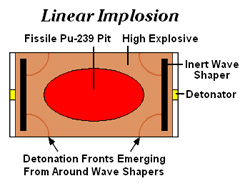
Linear_implosion_schematicAs disclosed in VizReport in 2005, Iran has likely been working with small-scale nuclear weapon designs since shortly after they received them from the A.Q. Khan proliferation network in the 1990s, along with some advanced centrifuge designs.

The warhead schematics, probably for Soviet-era scalable-yield nuclear landmine configurations, were designed to be small enough to be hidden inconspicuously on the battlefield, even inside hollowed-out rocks or logs. This also makes them ideal for deployment on small- to medium-scale ballistic or cruise missiles.

The same A.Q. Khan ‘care packages’ were received by Libya, North Korea and Iran, though Libya subsequently came clean and turned their materials over to the IAEA, effectively terminating their covert nuclear program. North Korea went on to produce a small arsenal of plutonium-driven atomic weapons, while Iran claims to be pursuing only a peaceful nuclear energy program. Today’s revelation, however, would seem to strongly suggest otherwise.

Furthermore, because the former Soviet designs were mostly plutonium-based, the IAEA investigation of Iran’s nuclear program may have perhaps focused erringly on its acknowledged uranium capabilities, rather than the possibility that it had initiated a dual-track weapons development approach.

More imahd.ca Iran coverage

~

For information on today’s disclosure, please read The Guardian’s story:

Exclusive coverage from The Guardian:

Iran tested advanced nuclear
warhead design – secret report

Watchdog fears Tehran has key component to put bombs in missiles

The UN’s nuclear watchdog has asked Iran to explain evidence suggesting that Iranian scientists have experimented with an advanced nuclear warhead design, the Guardian has learned.

The very existence of the technology, known as a “two-point implosion” device, is officially secret in both the US and Britain, but according to previously unpublished documentation in a dossier compiled by the International Atomic Energy Agency (IAEA), Iranian scientists may have tested high-explosive components of the design. The development was today described by nuclear experts as “breathtaking” and has added urgency to the effort to find a diplomatic solution to the Iranian nuclear crisis.

The sophisticated technology, once mastered, allows for the production of smaller and simpler warheads than older models. It reduces the diameter of a warhead and makes it easier to put a nuclear warhead on a missile.

Documentation referring to experiments testing a two-point detonation design are part of the evidence of nuclear weaponisation gathered by the IAEA and presented to Iran for its response.

The dossier, titled “Possible Military Dimensions of Iran’s Nuclear Program”, is drawn in part from reports submitted to it by western intelligence agencies.

The agency has in the past treated such reports with scepticism, particularly after the Iraq war. But its director general, Mohamed ElBaradei, has said the evidence of Iranian weaponisation “appears to have been derived from multiple sources over different periods of time, appears to be generally consistent, and is sufficiently comprehensive and detailed that it needs to be addressed by Iran”…

Continue reading

For more background on Pakistani scientist A.Q. Khan’s proliferation
network, see this
September 10th story from the Economist.

7 Comments

Filed under Chicanery, Conflict, Science