Category Archives: Conflict

Mideast: Dec. 8, 2009

Many small waves breaking at the same time. Strong undercurrents…

Lebanon
Israel appears to be moving toward giving up the north-half of the village of Ghajar to Lebanon, probably along with Shebaa Farms. This would effectively mean that no Lebanese territory would then be under Israeli control. (This could have been resolved much sooner, but for disagreements between Lebanon, Syria and the UN as to the true ownership of the lands in question.)

Residents of northern Ghajar who don’t wish to become Lebanese citizens would have the right (as full Israeli citizens) to remain in Israel, though they would have to leave their current homes in the north end of town. Some resettlement funds will probably be allotted by the government.

With the Israeli ‘occupation’ at an end, Hezbollah should stand down, but will they? They have recently deployed thousands of rockets south of the Litani River in direct contravention of multiple UN Security Council resolutions.

Syria
Indications seem to be that Syrian President Assad may be prepared to ‘get creative’ on certain issues related to the Golan Heights. (More on that soon…)

Gaza
Israel has notified various embassies that diplomatic visits to the Gaza Strip will not be possible through Israel at this time. While some people will be critical of the move, there’s an easy workaround for the problem — visit Gaza through Egypt instead.

If Hamas will not engage with Israel, then Israel should not be expected to facilitate the diplomatic adventures of Gaza’s overtly-militant Hamas government, which (only this week) tested out some new, sophisticated rockets freshly smuggled into the territory through its extensive tunnel network.

West Bank
As previously disclosed, PA PM Salam Fayyad will be running the show in Ramallah from now on, with PA President Mahmoud Abbas booking off work for an extended vacation.

There’s a distinct possibility that the Americans may be getting ready to hand over control of Palestinian security force training to the Brits and Canadians currently working on that mandate under US General Keith Dayton.

Upshot
The opportunity to achieve a lasting peace between Jewish and Arab Palestinians has rarely, if ever, been nearer. The opportunity to reach a peace deal between Israel and Syria, as well as between Israel and Lebanon, has absolutely never been closer.

But what about the Iranian ‘leadership’? They’re already dealing with fraying public control, a stumbling economy, apocalyptic delusions, looming international sanctions for their nuclear transgressions — and now this? Possible peace? It must be driving them crazy. And that’s the sort of thing that could be dangerous for everyone — if only because they’re the ones supplying the missiles to Hamas and Hezbollah.

1 Comment

Filed under Conflict, Peace

Freedom Spotlight: IRAN

Here’s a quick look at how Iran is
doing on several key freedom indices:

Corruption Perceptions Index 2009 – Transparency International
The CPI ranks countries based on their level of perceived public-sector corruption.
Ranking: 168/180; 2008: 141/180; Change: (-27)

Index of Economic Freedom 2009 – Heritage Foundation
The study ranks countries based on trade, labour, business and investment freedoms as well as property rights, government size and freedom from corruption.
Ranking: 168/179; 2008: 151/179; Change: (-17)

Press Freedom Index 2009 – Reporters Without Borders
The index ranks countries based on the freedom extended to journalists operating there, whether domestic or foreign.
Ranking: 172/175; 2008: 166/175; Change: (-6)

Looking on the positive side, um… well…
at least they have the internet…
for now
and they can’t possibly drop six spots on next year’s Press Freedom Index!

The Scoop…
Iranians experience the same sort of lower-level graft and corruption that can be found in other states of the region.

More concerning, Iran offers its public limited visibility into the dealings (fiscal and otherwise) of its local, regional and national governments.

This same lack of transparency is also evident in its key industries, a growing number of which are being operated by high-ranking members or former members of its Islamic Revolutionary Guard Corps (IRGC).

The country’s media are variously mitigated in their coverage of internal and international events by self-censorship, government ownership or control, influence of the clergy, or even stern warnings from officials of the government or the Bassij — the multi-million member Islamic students paramilitary group often charged with local crowd control and dress code enforcement.

Foreign and domestic reporters have been arrested for investigating government activities and covering news events, most recently during the civil disobedience that followed the 2009 Presidential elections, the results of which many agree were pre-determined by the government itself.

The country’s main source of revenue comes from oil and gas exports, which are primarily nationalised. Most of the boon dollars from high oil prices in 2006-08 were ploughed into fruitless subsidies and a quickly expanding military complex.

Economic diversification is somewhat limited. Foreign investment is slow in coming due to international financial sanctions and concerns about Iran’s nuclear program. This provides fewer (and weaker) investment opportunities for Iranians (and others) to invest in Iranian businesses.

Unfortunately, they are also trending in the wrong direction on all indices.

~

More bad news: US State Department report on Religious Freedom in Iran.

Leave a comment

Filed under Chicanery, Conflict, Economy

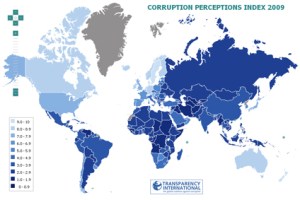
Corruption Index 2009

Transparency International, a global anti-corruption group, has released the results of its 2009 Corruption Perceptions Index (CPI) surveys of 180 countries.

Leading the list of most ‘trustable’ countries, with low perceived public-sector corruption, were: New Zealand, Denmark, Singapore, Sweden, Switzerland, Finland, Netherlands, Australia, Canada and Iceland.

At the very bottom of the pile: Burundi, Equatorial Guinea, Guinea, Haiti, Iran, Turkmenistan, Uzbekistan, Chad, Iraq, Sudan, Myanmar, Afghanistan and Somalia.

Russia and Ukraine scored poorly; each finished tied for 146th place with Cameroon, Ecuador, Kenya, Sierra Leone, East Timor and Zimbabwe. The UK and US finished 17th and 19th, respectively. Qatar was 22nd. France came in at #24. Israel and Spain tied for the 32nd spot.

Hugo Chavez’s Venezuela turned in a dismal showing, slipping to 162nd (158th last year) and barely missing inclusion in the ‘dirty dozen’ by a single point.

For more info and to find out how your favourite country did, click here.

Leave a comment

Filed under Chicanery, Conflict, Economy

Palestine at the Crossroads

The main issue currently in the public eye is the possibility that the Palestinians may declare their own state independent of negotiations with Israel. Palestinian National Authority President Mahmoud Abbas said as much last week, and since then, PA spokesman Saeb Erekat has been heavily pumping that message.

The idea hasn’t been gaining much traction with Security Council members — or the Israeli government, which has announced that it could also act unilaterally; possibly by protectively annexing existing Jewish settlements in the West Bank.

Ultimately, the Palestinians certainly will have to declare a state for themselves — I mean, no one else can declare your independence for you — but the idea that all the Palestinian factions could come together and decide upon definitive boundaries for their intended state seems far-fatched. Hamas and Islamic Jihad (just to name two) are convinced that their state should also include all of Israel!

The one to watch in this situation is not President Abbas, but Salaam Fayad, the Fatah-backed PM. He’s smart and pragmatic and has proven in the past to be an honest partner for the Israelis. He readily admits that Palestine doesn’t yet have the necessary infrastructure to properly govern itself, but feels that this goal is attainable within two years.

Of course, Iran and its proxies always have to be treated as a wildcard.

So does Avigdor Lieberman; whatever will he say next? (Perhaps I’m being unfair to the Israeli Foreign Minister. Most people will–even if reluctantly–agree that Mr. Lieberman has been a great deal less controversial than expected.)

UPDATE: (Nov. 18) Erekat is now singing a different tune, saying that the aim is only to get international bodies on-side with recognising the pre-1967 borders of Palestine.

(Note: This notion will get some lip service, but a final resolution on borders will only come during negotiations with Israel. The most likely result will be a state line that follows the pre-’67 border though about 93% of its length, with any shortfalls in Palestinian land area being supplemented by land grants from adjoining Israeli properties to the northwest and southwest of the current West Bank territory. Gaza’s borders would remain unchanged since there are absolutely no Israelis living there.

However, a nice cherry on top of any final agreement of the situation would be a minimum 20% expansion of the Gaza territory through donations of property from both Egypt and Israel. This would provide more room for growth and development; reduce population crowding; and mitigate many risks to Israeli and Egyptian security now posed by Gaza’s extensive tunnel network.)

~

Read our take on Middle East peace: A Peace of Jerusalem

Short wikipedia entry on Salaam Fayad.

JPost article about Mr. Fayad’s stance on the current issue.

2 Comments

Filed under Conflict, Reason

Chavez: Prepare for War Against U.S?

Hugo Chavez in painting

(Joe Raedle/Getty Images)

Venezuelan president Hugo Chavez has told his military to prepare for war against the United States.

Citing American use of Colombian military bases for anti-drug interdictions, Chavez asserts that Colombia has now become part of the United States and that American troops may attempt to invade Venezuela.

(Bloomberg) […] “The empire hopes to send them to fight against their Venezuelan and Ecuadorean brothers and other Bolivarian and Alba peoples to crush the Venezuelan revolution, just as they tried to do with the Cuban revolution in April 1961,” Castro wrote in a “reflection” published on the Cubadebate.cu Web site. The Alba bloc is a nine-member group of Latin American countries led by Chavez.

The presence of U.S. troops in Colombia is a “shameless foreign intervention in their internal affairs,” Castro said. The agreement amounts to the U.S.’s “annexation” of the South American country, he said.

A military attack on Venezuela would spread to other countries in the region because Venezuela has “friends” from Mexico to Argentina, Chavez said during the program.

“If the Yankee empire tries to use Colombia to attack Venezuela, the war of 100 years would begin,” he said. “The war would extend to other countries in the continent, from Mexico to Argentina. No one believes that a war against Venezuela would only be in Venezuela.” […]

Continue reading

Another interesting aspect of Venezuelan politics under Chavez

1 Comment

Filed under Chicanery, Conflict