
© 2009
A beam of light travels from Point A to Point B.
You, a scientist, measure its rate of progress on that journey and aren’t surprised to find that it agrees precisely with the universal standard, just as it did countless times before. But you verify it anyway because you’re diligent – and there’s always that slim but tantalising chance that you might find a cool anomaly.
And then it happens.
You glance up from your computer screen and your eyes come to rest on a poster of Einstein that one of your co-workers has crookedly taped to the wall above his workstation.
The moment passes and you look away, but something seems changed. It’s nothing you can define. Everything just ‘feels’ different. You smell your coffee to make sure the cream hasn’t gone bad. You’re slightly concerned, but decide to carry on because you’re diligent – and there’s always a chance that your boss might pop in… and you still owe him a report. Okay, so maybe you’re not that diligent, but at least you’re earnest.
So, you continue working on your report. It’s difficult to stay focused, but you doggedly persist. After 20 minutes, you stop short.
You check to make sure that no one’s around – and then you say out loud what you’ve been thinking for the past half hour:
“If time slows down as you approach c and theoretically stops there, then how do we account for light’s measured progress through our space/time-frame?”
 This week’s visit by Pope Benedict XVI to the Middle East has been controversial, but only partly due to the fact that he was once enrolled in the Hitler Youth movement as a young boy in World War II Germany.
Some in Israel felt that he should have undertaken a more personal mea culpa during his visit to the Yad Vashem Holocaust Remembrance Centre. Others were more inclined to let that slide given his solemnly remorseful comments on the subject in the recent past.
During an interfaith dialogue at the Notre Dame Jerusalem Centre, the Pope exited the room after the Chief Islamic Judge of the Palestinian Authority, Sheikh Tamimi, launched into an anti-Israeli rant and called for Christians and Muslims to rise up together against the ‘murderous Israelis’.
In the West Bank today, Pope Benedict made it clear that he stood behind the establishment of a sovereign, independent Palestinian state. This was actually one of the least controversial moments of his trip because a majority of Israelis and Palestinians happen to feel the same way – as do most other people in the world.
But having the Pope advocate for a Palestinian state is not the same thing as Palestinians declaring their own state. And therein lies the rub. No one can declare independence on someone else’s behalf. It must be self-declared.
The main problem seems to be that the Palestinian Authority, Hamas, Islamic Jihad, et al, cannot decide exactly where that state will be. A solid majority of these organisations appear to believe that a Palestinian state should be established not only in the West Bank and Gaza Strip, but right across the entire UN-member state called Israel. And that simply won’t work.
To distance ourselves from this personal darkness, we often externalise the danger and personify it in different ways; a technique that is used so effectively in films of the horror genre. The struggle of the protagonist in each of these scary stories represents our desperate yearning not to succumb to our darker urges.
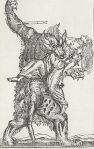 The werewolf is a man or woman (most often a man) whose curse it is to viciously murder the one whom he best loves – especially when external forces beyond his control (symbolised by the full moon) bring his animal nature closer to the surface. Is there a better profile of fatal domestic abuse? But after the death of his beloved, the werewolf isn’t free of his curse; he then becomes the loner who feels compelled to objectify, stalk and murder those unfortunate enough to rouse his monthly ire.
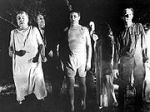 Zombie rage is perhaps Hollywood’s best metaphor of the rampant, mindless, seething mob. They are the sick; the destitute; the hungry – often ravenously so. And their rage is contagious, like a virus. In fact, a virus (whether from space or homegrown) is often held to blame for their actions in most screenplays. But how many missed paychecks are any of us from becoming dispossessed scavengers?
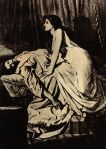 Vampires are creatures of privilege who drain the peasantry dry. They live for centuries, or even thousands of years, in mimicry of the royal houses whose progeny are to the manor borne. Lately, vampires have been getting more favourable play in films such as Interview with the Vampire, Underworld and Twilight. They have often been portrayed as somewhat less odious than other monsters, but today’s cinematic vampire is sexy, rich, bold and immortal – almost cool enough to make one forget their parasitic nature.

Under the category “Fear of the Unknown”, we find such monsters as The Blob, The Thing, ghosts, poltergeists, invisible aliens, demons, unseen psychos, etc. Given enough of a budget, superior visual effects, mass advertising, hype and hysteria, I imagine that it is possible to make people afraid of just about anything.
But, as Franklin Delano Roosevelt uttered in his first inaugural address:
“So, first of all, let me assert my firm belief that the only thing we have to fear is fear itself — nameless, unreasoning, unjustified terror which paralyzes needed efforts to convert retreat into advance.”
And, as Frank Herbert wrote in his epic novel Dune, “Fear is the mindkiller.”
Or, as Pogo once observed, “We have met the enemy and he is us.”
The word ‘monolith’ denotes something that is massive and uniform. As such, it can be applied to anything from a large, continuous piece of stone to a person of towering, unique intellect – someone who stands alone in his or her field of endeavour. In the latter case, there is perhaps no more perfect an example than that of the late professor Albert Einstein.
Had he not existed, we would not have GPS systems because the satellites can only be coordinated using the principles enshrined in his theories of Relativity. We might not even have television because he was the one who defined the photoelectric effect. Let’s not even tread into the more esoteric worlds of gravitational lensing, Bose-Einstein condensates, or the Einstein-Podolsky-Rosen paradox.
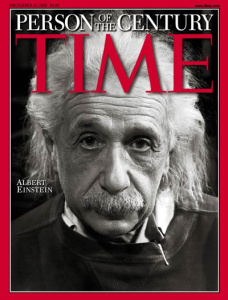 At the conclusion of 1999, Time magazine declared him to be the Person of the Century. FDR and Gandhi were mere runners-up.
Whether a matter of sheer coincidence or some bizarre manifestation of destiny, the name Einstein may have held a clue about the potential of this singularly impressive individual.
EINSTEIN =
EIN + STEIN (German) =
ONE + STONE (English) =
MONO + LITH (Latin) =
MONOLITH
A note about the cover shot from Time:
The iconic image of Einstein on our cover was taken in 1947 by the legendary photographer Philippe Halsman. Einstein was not fond of photographers (he called them Lichtaffen, or light monkeys), but he had a soft spot for Halsman. Einstein had personally included the photographer on a list of German artists and scientists getting emergency U.S. visas to evade Nazi capture. Halsman recalled that Einstein ruminated painfully in his study on the legacy of E=mc²: talk of atomic war, an arms race. “So you don’t believe that there will ever be peace?” Halsman asked as he released the shutter. Einstein’s eyes, Halsman said, “had a look of immense sadness…a question and a reproach in them.” He answered, “No. As long as there will be man, there will be war.”
Most people don’t have the time or patience required to understand the physics of Einstein, so I’m posting this practical explanation of what could be called Basic Relativity, as opposed to Einstein’s Special or General theories of Relativity.
It was derived in very much the same way that Einstein initiated his own theories – through rigorous, logical thought experiments and a healthy dose of creative intuition. (Generally, for Einstein, the formal mathematics to support his theories came in the secondary stage of his theoretical explorations.)
So, here’s a straight-forward, logical statement on Relativity (in 10 words or less) that doesn’t break any physical laws and which can even be seen to underpin many of those accepted rules – including the absolutely fundamental inverse square law. The principle (along with a simple mathematical proof) was developed by an amateur cosmologist in 2005.
Steinman’s theorem simply states:
—
Proof:
matter : energy = time : space
m : e = t : s
m / 1 : e / 1 = 1 / v : v / 1
(v is velocity or acceleration)
e = mv²
(in the ultimate case, e = mc²)
—

~
UPDATE: December 1, 2009
In response to requests for additional information on this topic, here is an addendum posted by Mr. Steinman to a related IOP [Institute of Physics] discussion group thread on LinkedIn…
~
I can fully understand that it’s difficult to grasp the concept:
“Matter is to energy as time is to space.” ~ But that’s the way things work.
In Gary’s [Dr. Navrotski’s] earlier response, he cited E(k)= ½mv² (the kinetic energy of a rigid body in motion) which aligns perfectly with Einstein’s Relativity. (Note: It is “½m” because the other half of the mass would be contributed in any collision by the body which is struck, à la Newton’s Third Law.)
The key to my challenge [as defined in the IOP discussion] was the word “absolute”, since this is when c embodies the most acute aspect of the accelerative component and reveals itself as absolutely central to nuclear reactivity.
Though the matter of “why” is addressed in the logical statement, the following may help to identify “how” c creeps into the calculation:
In a four-variable equation, you need to resolve at least two of them in order to extract any significant meaning.
The first thing to test is an absolute. Ideally, you’d want to interject a constant that satisfies two of the four variables.
There’s only one universal constant ( c : speed of light in vacuo) that applies to two of the four variables (in this case, time and space) without any need for statistical uncertainty (in Newtonian G uncertainty is 1.0 x 10^-4; the Planck and reducedPlanck constants have an uncertainty factor of 5.0 x 10^-8).
So, plug in the appropriate, defined, universal constant ( c ).
But you can’t plug c directly into both the Time and Space placeholders without a very minor adjustment:
For Time, it must be stated as the amount of time required for light to travel one standard unit of distance ( 1 / c ). For Space, it is the distance traversed by light in one standard unit of time ( c / 1 ). This reflects the interrelated nature of space and time as a true continuum.
This works regardless which set of standard units is used.
(Note: It may help to view time as latency; how fast something DOESN’T happen.)
After cross-multiplying the equation, you get e = mc², which conforms precisely to Einstein’s Relativity principle for mass-energy equivalence.
The nine-word statement (“matter is to energy as time is to space”) can serve as an answer to the original question (Why c² in e = mc² ?) or it can be viewed as a description of Relativity in its most fundamentally naked form.
While the logic of equating m/e to t/s will seem completely obtuse to most readers, the simplicity of the proof is inescapable.
Simple, but not overly so. (Some do find it maddening.)
Viewing things through the prism of “matter is to energy as time is to space”, you will find that none of the established laws are broken ~ only gently bent.
Filed under 10 Words or Less, Reason, Science

 imahd.ca