Freedom Spotlight: IRAN

Here’s a quick look at how Iran is
doing on several key freedom indices:

Corruption Perceptions Index 2009 – Transparency International
The CPI ranks countries based on their level of perceived public-sector corruption.
Ranking: 168/180; 2008: 141/180; Change: (-27)

Index of Economic Freedom 2009 – Heritage Foundation
The study ranks countries based on trade, labour, business and investment freedoms as well as property rights, government size and freedom from corruption.
Ranking: 168/179; 2008: 151/179; Change: (-17)

Press Freedom Index 2009 – Reporters Without Borders
The index ranks countries based on the freedom extended to journalists operating there, whether domestic or foreign.
Ranking: 172/175; 2008: 166/175; Change: (-6)

Looking on the positive side, um… well…
at least they have the internet…
for now
and they can’t possibly drop six spots on next year’s Press Freedom Index!

The Scoop…
Iranians experience the same sort of lower-level graft and corruption that can be found in other states of the region.

More concerning, Iran offers its public limited visibility into the dealings (fiscal and otherwise) of its local, regional and national governments.

This same lack of transparency is also evident in its key industries, a growing number of which are being operated by high-ranking members or former members of its Islamic Revolutionary Guard Corps (IRGC).

The country’s media are variously mitigated in their coverage of internal and international events by self-censorship, government ownership or control, influence of the clergy, or even stern warnings from officials of the government or the Bassij — the multi-million member Islamic students paramilitary group often charged with local crowd control and dress code enforcement.

Foreign and domestic reporters have been arrested for investigating government activities and covering news events, most recently during the civil disobedience that followed the 2009 Presidential elections, the results of which many agree were pre-determined by the government itself.

The country’s main source of revenue comes from oil and gas exports, which are primarily nationalised. Most of the boon dollars from high oil prices in 2006-08 were ploughed into fruitless subsidies and a quickly expanding military complex.

Economic diversification is somewhat limited. Foreign investment is slow in coming due to international financial sanctions and concerns about Iran’s nuclear program. This provides fewer (and weaker) investment opportunities for Iranians (and others) to invest in Iranian businesses.

Unfortunately, they are also trending in the wrong direction on all indices.

~

More bad news: US State Department report on Religious Freedom in Iran.

Leave a comment

Filed under Chicanery, Conflict, Economy

Corruption Index 2009

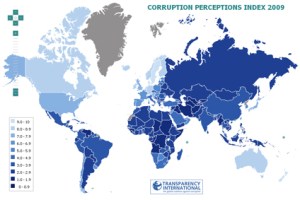
Transparency International, a global anti-corruption group, has released the results of its 2009 Corruption Perceptions Index (CPI) surveys of 180 countries.

Leading the list of most ‘trustable’ countries, with low perceived public-sector corruption, were: New Zealand, Denmark, Singapore, Sweden, Switzerland, Finland, Netherlands, Australia, Canada and Iceland.

At the very bottom of the pile: Burundi, Equatorial Guinea, Guinea, Haiti, Iran, Turkmenistan, Uzbekistan, Chad, Iraq, Sudan, Myanmar, Afghanistan and Somalia.

Russia and Ukraine scored poorly; each finished tied for 146th place with Cameroon, Ecuador, Kenya, Sierra Leone, East Timor and Zimbabwe. The UK and US finished 17th and 19th, respectively. Qatar was 22nd. France came in at #24. Israel and Spain tied for the 32nd spot.

Hugo Chavez’s Venezuela turned in a dismal showing, slipping to 162nd (158th last year) and barely missing inclusion in the ‘dirty dozen’ by a single point.

For more info and to find out how your favourite country did, click here.

Leave a comment

Filed under Chicanery, Conflict, Economy

Palestine at the Crossroads

The main issue currently in the public eye is the possibility that the Palestinians may declare their own state independent of negotiations with Israel. Palestinian National Authority President Mahmoud Abbas said as much last week, and since then, PA spokesman Saeb Erekat has been heavily pumping that message.

The idea hasn’t been gaining much traction with Security Council members — or the Israeli government, which has announced that it could also act unilaterally; possibly by protectively annexing existing Jewish settlements in the West Bank.

Ultimately, the Palestinians certainly will have to declare a state for themselves — I mean, no one else can declare your independence for you — but the idea that all the Palestinian factions could come together and decide upon definitive boundaries for their intended state seems far-fatched. Hamas and Islamic Jihad (just to name two) are convinced that their state should also include all of Israel!

The one to watch in this situation is not President Abbas, but Salaam Fayad, the Fatah-backed PM. He’s smart and pragmatic and has proven in the past to be an honest partner for the Israelis. He readily admits that Palestine doesn’t yet have the necessary infrastructure to properly govern itself, but feels that this goal is attainable within two years.

Of course, Iran and its proxies always have to be treated as a wildcard.

So does Avigdor Lieberman; whatever will he say next? (Perhaps I’m being unfair to the Israeli Foreign Minister. Most people will–even if reluctantly–agree that Mr. Lieberman has been a great deal less controversial than expected.)

UPDATE: (Nov. 18) Erekat is now singing a different tune, saying that the aim is only to get international bodies on-side with recognising the pre-1967 borders of Palestine.

(Note: This notion will get some lip service, but a final resolution on borders will only come during negotiations with Israel. The most likely result will be a state line that follows the pre-’67 border though about 93% of its length, with any shortfalls in Palestinian land area being supplemented by land grants from adjoining Israeli properties to the northwest and southwest of the current West Bank territory. Gaza’s borders would remain unchanged since there are absolutely no Israelis living there.

However, a nice cherry on top of any final agreement of the situation would be a minimum 20% expansion of the Gaza territory through donations of property from both Egypt and Israel. This would provide more room for growth and development; reduce population crowding; and mitigate many risks to Israeli and Egyptian security now posed by Gaza’s extensive tunnel network.)

~

Read our take on Middle East peace: A Peace of Jerusalem

Short wikipedia entry on Salaam Fayad.

JPost article about Mr. Fayad’s stance on the current issue.

2 Comments

Filed under Conflict, Reason

Why Jews are Good at Math

Jewish children learn early on about numbers and their properties

It’s commonly accepted that Jews do well in math and science because there’s such a strong emphasis on learning within their tradition, as well as amongst Jewish families in general. But can good study habits and parental prompting account for the incredibly disproportionate share of awards (Nobel and others) that have been garnered by Jewish mathematicians and scientists?

Why would a people making up such a small percentage (~0.25%) of the global population earn 25% (or more) of the world’s top prizes in economics, physics, mathematics and medicine?

To delve a little deeper into why this might be, we will explore how the structure of the religion may play a crucial role in embedding complex social, mathematical and dimensional associations into the Jewish psyche in very subtle ways.

~

Modes of mathematical unity in progressive dimensions
(as embodied in the Hebrew teachings)

.

First Dimension (numbers)
Ten as One: Accounting 101

The Hebraic numeral system is one of the oldest decimal systems in existence. The letters of the aleph-bet (aleph through yod shown below) have number values according to their placement in the alphabet.

The number ten, yod, is the next logical step in the evolution of unity from the number one, aleph, just as in the modern decimal model. (In a way, yod is a more ‘concentrated’ form of ‘singularity’ than aleph, because aleph also reflects the fundamental duality present in the creation; the division of light from darkness; the division of ‘waters above’ from ‘waters below’. This is visually expressed in how an aleph is drawn. Below, right.)

Great emphasis is placed on the number ten in Jewish lore and practice: Ten are the primary commandments. Ten are the Lost Tribes. One-tenth is for tithing. Ten were the plagues of Egypt. Ten are the Days of Repentance. Ten is the quorum of group prayer. Ten are the Sephirot of the Kabbalistic Tree of Life. Ten were the generations between Adam and Noah. Ten were the generations between Noah and Abraham.

.

Second Dimension (shapes)
Seven as One: A cyclical view of time and space

The most basic 2-dimensional shape is the circle; all points along its perimeter are equidistant from its centre. It takes seven circles (one in the centre and six around it) to achieve the next most efficient (and unified) use of 2D space using multiples of the same-sized circles. (This applies not only to flat [2D] shapes but also to extruded [3D] forms thereof.)
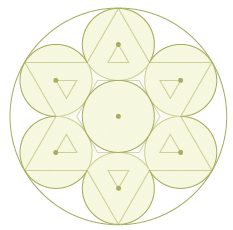
This lesson can be demonstrated at home with cookies of the same variety or equal-sized coins; echoes of it are to be found everywhere in nature, from honeycombs (extrusions) to snowflakes (polarised ions that attract and consolidate water vapours along flat, crystalline planes) to the most common carbon-ring molecules, like benzene or hexane.

The “seven as one” progression engenders the familiar six-pointed star (Star of David or Seal of Solomon) and represents the seven days of the week as individual cycles of equal length (circumference), six of which are equally anchored to the seventh day (Shabbat), the Holy Day.

The seventh is G-d’s day of rest. Seven are the days of the purification cycle. In the seventh year, a field should be left fallow. A debt should be forgiven after seven years. A Jubilee year follows seven times seven years. The Counting of the Omer is seven times seven days. Seven are the days of mourning (Shiva). Seven are the aliyahs. Seven are the windings of marriage. Seven are the wedding benedictions. Seven are the Shepherds; Abraham, Isaac, Jacob, Joseph, Moses, Aaron and David. Seven are the branches of the Menorah in the Tabernacle. Seven-fold would be G-d’s vengeance for the murder of Cain. Lemech lived for 777 years. The Israelites circled Jericho for seven days, after which, its walls came tumbling down.

.

Third Dimension (forms)
Thirteen as One – The unseen aspects of unity

Moving from circles to spheres (2D to 3D), we find that it takes twelve equal-size spheres to enclose (hide) a central sphere of the same size. Each sphere perfectly touches its five neighbours as well as the centre sphere.

Each sphere can symbolise a year in the life of a male child, culminating in the age of Bar Mitzvah (son of the commandments), at thirteen. The kind of man he will be, however, is still for him to determine through his own future decisions. Female children are honoured upon reaching the age of twelve (Bat Mitzvah), signifying their nature as vessels intended to bear the “hidden” unity of a nascent individual.

Thirteen are the tribes; Joseph was split into two tribes, Ephraim and Menashe, whereupon the Levites became the (esoteric) thirteenth tribe. Thirteen are the Articles of Faith as described by Maimonides. Thirteen are the merciful attributes of G-d set down in the Torah. Thirteen are the nodes of Metatron’s Cube in Kabbalah. Adar II is the 13th (semi-hidden, intercalary) month of the year.

Thirteen is at the crux of the Newton-Gregory Problem (year: 1694), defined during an argument between David Gregory and Isaac Newton. Linear calculations and harmonic analysis show that the number of equal-sized spheres touching a common sphere cannot exceed thirteen, but in using this calculation method, thirteen is likewise shown to be impossible — unless, of course, the centre sphere is recognised to be touching itself (i.e. being self-relative as well as relative to the greater whole).

.

The Most Primary Number (The Ultimate One)
One as One as One

This is not the same as aleph’s “#1”, but is The One that cannot and should not be named.

Each of the foregoing modes of unity were derived by projecting “multiples of one” into the most fitting analogs of “oneness” at each basic level of dimensional reality. G-d, meanwhile, is ever One. Ever was and ever will be. There are no multiples.

This primary tenet of monotheistic unity in Judaism is boldly embodied in one of the chief prayers of the religion; the Shèma (which means “to hear”).

Hear, O Israel! The Lord is G-d; The Lord is One.

~

Obviously, a person doesn’t have to be Jewish in order to be smart, but it apparently does help. How much of that effect is due to the influence of community and genetics; the way in which mathematics is woven into the religious culture and narrative; the acquisition of the ability to read and write in either lateral direction — is probably unknowable.
It should, of course, also be stated that none of the preceding is intended to strip credit from persistent and devoted Jewish mothers everywhere for the achievements of their sons and daughters. This has simply been an exercise in reminding us Where Else credit is always rightly due.
.

3 Comments

Filed under Esoterics, Reason

The Search for a Cure Continues

LIFE: A chronic, ubiquitous, ailment about which we actually know very little. Doctors generally advise that it be allowed to run its course, even though death is to be expected in 100% of cases.

While scientists agree that more research is the answer, billions of dollars are already expended annually to combat the rising tide of infection — trillions, if military applications are included.

Some researchers, citing the OPPC (ounce of prevention vs. pound of cure) axiom, maintain that prevention is the only viable strategy. However, that argument is rejected by those who contend that any such program could risk the pre-emption of an individual otherwise fated to discover the elusive cure.

The World Health Organization predicts that the number of people afflicted by the condition will soon rise to seven billion.

5 Comments

Filed under Humour, Life