Tag Archives: Middle East

Threat Level Revised to ‘Hot Paisley’

GLOBAL THREAT LEVEL:

HOT PAISLEY

paisley
Please be advised that a recent spike
in the
conflict propensity index has
triggered an elevation of the current
Global Threat Level to Hot Paisley.

This condition will continue for the next
30 days, but may be revised at any time.

Leave a comment

Filed under Conflict, Humour, Images, Words

Khamenei May Call for New Elections

In the wake of a finding by the Council of Guardians that there were widespread voting irregularities in last week’s presidential election, some observers are now expecting a quick call from Grand Ayatollah Ali Khamenei for a new round of polling. They feel that Khamenei, who had very publicly (and very personally) assured the Iranian people that the vote was indeed free and fair, will be looking for a way to save face and salvage what remains of his tattered credibility — along with that of the entire regime.

The Council has been careful to leave a plausible “out” for the Supreme Ruler, stating that over-voting in some districts is a “normal phenomenon”. This will afford Ayatollah Khamenei the opportunity to make his own ruling on the matter — but, in all likelihood, not before a semblance of order is restored.

All eyes (and suspicions) will then turn to President Mahmoud Ahmadinejad, who will, no doubt, try to deflect all responsibility for the debacle by shifting the blame for ballot-stuffing onto “agents of the arrogant foreign powers” and, of course, the “Israeli Mossad”.

One back-channel rumour suggests that arrest warrants may already have been issued for several individuals — including one or more of Ahmadinejad’s advisors. There has been no independent confirmation of this rumour, but many are hoping that it’s true.

Wishful thinking? We’ll have to wait and see.

Related: New York Times coverage

1 Comment

Filed under Chicanery

ELECTION IRAN 09: Guardian Council Finds Widespread Voting Irregularities

Guardian Council:
Over 100% voted in 50 cities

Sun, 21 Jun 2009 23:33:38 GMT

The Guardian Council Spokesman Abbas-Ali Kadkhodaei

The Guardian Council Spokesman Abbas-Ali Kadkhodaei

(PRESSTV.IR) Iran’s Guardian Council has suggested that the number of votes collected in 50 cities surpass the number of people eligible to cast ballot in those areas.

The council’s Spokesman Abbas-Ali Kadkhodaei, who was speaking on the Islamic Republic of Iran Broadcasting (IRIB) Channel 2 on Sunday, made the remarks in response to complaints filed by Mohsen Rezaei — a defeated candidate in the June 12 Presidential election.

“Statistics provided by the candidates, who claim more than 100% of those eligible have cast their ballot in 80-170 cities are not accurate — the incident has happened in only 50 cities,” Kadkhodaei said.

The spokesman, however, said that although the vote tally affected by such an irregularity could be over 3 million and the council could, at the request of the candidates, re-count the affected ballot boxes, “it has yet to be determined whether the possible change in the tally is decisive in the election results,” reported Khabaronline.

Three of the four candidates contesting in last Friday’s presidential election cried foul, once the Interior Ministry announced the results – according to which incumbent President Mahmoud Ahmadinejad was declared the winner with almost two-thirds of the vote.

Rezaei, along with Mir-Hossein Mousavi and Mehdi Karroubi, reported more than 646 ‘irregularities’ in the electoral process and submitted their complaints to the body responsible for overseeing the election — the Guardian Council.

Mousavi and Karroubi have called on the council to nullify Friday’s vote and hold the election anew. This is while President Ahmadinejad and his Interior Minister Sadeq Mahsouli have rejected any possibility of fraud, saying that the election was free and fair.

MMN/SME/MMN


The above statement is the Council of Guardians’ way of passing its own vote of non-confidence on the government’s handling of both the election procedure and the aftermath of the event. They do not wish to be tainted by the obvious corruption of the recent presidential poll as this would further blemish and endanger Iran’s “Islamic Revolution”. A number of key clerics on the Council also seem to feel threatened by the pressure applied to Ayatollah Rafsanjani, his family, and others (like candidate and former PM Mir-Hossein Mousavi) who have voiced disbelief at the result of last week’s presidential vote. If president-“elect” Ahmadinejad and Ayatollah Jannati are going to attempt a power play against Rafsanjani and Mousavi, then they will have to muscle past the Guardian Council to get to them. — Ed.

RELATED: Revolution within the Revolution

Good insight/detail available on the Voting Matters Blog

1 Comment

Filed under Chicanery

Revolution within the Revolution

iran_573958aA nationwide crackdown on voter protests by Iranian authorities has resulted in the deaths of at least ten people, according to Iranian government sources. Hospital officials put the death toll at 19, but reports from CNN and other news agencies indicate that as many as 150 may have died since a strong, public backlash erupted last week over the country’s June 12th presidential election results.

GKXFRafsanjani Muzzled?
The daughter of former Iranian President Ayatollah Akbar Hashemi Rafsanjani has reportedly been arrested by police for allegedly fomenting violence. Four other family members of the prominent cleric have also been detained. (UPDATE: June 22, 2009, 12:49 AM EDT – Rafsanjani’s Daughter Released) There has so far been no formal statement on this matter from Rafsanjani who has been conspicuously silent since just after the disputed election results confirmed the return to office of hardline president Mahmoud Ahmadinejad. At the time of this posting, Rafsanjani’s website (like many others across the nation) has been taken offline. (UPDATE: June 22, 2009, 2:15 AM EDT – Website back on-line.)

iran hashemi rafsanjaniRafsanjani is the Chairman of the powerful Expediency Council as well as the pivotal Assembly of Experts; the latter of which has the power to dismiss the Supreme Ruler, an office presently held by Ayatollah Ali Khamenei. This could set the stage for a possible showdown between the country’s two most dominant clerics.

Ayatollah Rafsanjani (one of the richest and most influential men in Iran) would have been a contender for the presidency, but he turned 75 years old before election day and was therefore ineligible.

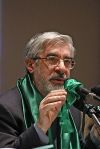
225px-Mir_Hossein_Mousavi_in_Zanjan_by_MardetanhaChallenger Forced Underground?
Chief election challenger Mir Hossein Mousavi has called for a nationwide general strike in the event of his arrest by authorities, stating that he is prepared for martyrdom. Neither Mr. Mousavi nor Mr. Karroubi nor Mr. Rezai (all candidates who have challenged the official results) showed up at Saturday’s Council of Guardians meeting initiated to consider the more than 600 objections lodged over the contested poll results. There was apparently some concern among the candidates that they would be arrested immediately upon arrival at the hearing.

Ayatollah Khamenei

Ayatollah Khamenei

A Severe Shortage of Real Choices
Mr. Mousavi, a former Prime Minister of the Iranian government during the 1980s, is currently seen as a ‘moderate’ though he did support forceful suppression of popular change during his term in office. Ayatollah Rafsanjani, though presently opposing the election of Mr. Ahmadinejad, has frequently been less than moderate in his own positions; in 2001 and again in 2003, he appeared to advocate an Iranian nuclear strike against the State of Israel, which is generally viewed as an “agent of Satan” by Iran’s ruling theocratic elite. Mr. Rezai, too, is a staunch conservative and the former Commander of the Iranian Revolutionary Guard Corps. Mr. Karroubi is seen by some in Iran to be a reformist, but he bears a strong allegiance to the current Supreme Ruler Khamenei and was appointed by the Grand Ayatollah to his current position.

playersDuring each of the past several elections, thousands of potential candidates have been rejected by the government and declared ineligible to run.

A Dearth of Perspectives — But News Leaks Out
Most foreign news media personnel have been expelled from the country, but citizens are using the Internet (despite concerted attempts to block such network traffic) to sneak out images—and even video—of breaking events as they transpire.

Massive street demonstration captured on cellphone video-cam:

Should the revolutionary Islamic regime perceive a high level of threat against its authority (especially if protests engulf the southwest of the country) then it is possible that we may see the sort of response predicted by VizReport in its March 1, 2006, coverage of the evolving situation in Iran.

1 Comment

Filed under Chicanery, Conflict

Bibi Sets the Tone

protretAccording to the June 14th speech by Israeli Prime Minister Benjamin (Bibi) Netanyahu, there are certain “red lines” that Israel will not cross in pursuing peace with its Arab Palestinian neighbours.
(Full text of  address)

Condensed into a few points (with comments):

Israel must be secure. The security argument is based generally upon two needs: 1) That all of Israel’s borders must be defensible; and 2) That any eventual Palestinian state not be permitted to have a standing army or be able to conclude defensive pacts or military alliances with other countries – Iran was specifically mentioned by name because it arms and otherwise supports such groups as Hezbollah and Hamas.

This doesn’t mean that the Palestinian state will be prohibited from having internal security services adequate to the maintenance of order within its territory — in fact, the Palestinian Authority has largely been armed by Israel and the United States.

Beyond Palestine’s imagined borders would rest Jordan, Egypt and, of course, Israel. If any future peace agreement contained commitments by each of these countries to defend Palestine from external attack, why would the young state want to bear the expense of maintaining an army?


Israel must primarily be a Jewish state
, with freedom of religion for all faiths. This touches upon an important demographic requirement: That the Palestinian refugee problem be settled outside of Israel proper (i.e. within the future borders of a Palestinian state).

Aside from the social and economic chaos that would result if Israel (a very small country) was forced to absorb literally millions of Palestinian refugees, there is also a politically existential angle; since Israel is a democracy, it would be exposed to the very real risk of voting itself out of existence.

Egyptian President Hosni Mubarak implied that no Arab country would ever recognise Israel as a Jewish state, being situated as it is, so close to the heart of the Islamic world. This could be seen as somewhat hypocritical since Egypt does recognise more than a half dozen countries that are officially Islamic states, as well as sixteen nations (plus itself) which have officially adopted Islam as their state religion.


Jerusalem must remain the undivided capital of Israel.
Jews feel and think about Jerusalem in somewhat the same way that Muslims feel about Mecca. Muslims have prayed facing in the direction Mecca for about 1400 years. Jews have been praying towards Jerusalem since Solomon’s edict to do so — almost 3000 years ago.

Though most of the region’s inhabitants were used to praying while facing Jerusalem (most of them being Jews or early Christians who also maintained the established practice), Mohammed issued an edict requiring that all Muslims pray in the direction of Mecca. Ironically, Mecca was itself established and controlled by the Jewish Quraish tribe for centuries prior to the arrival of Mohammed.

Jerusalem is central to the identity of the Jews and is foremost, of all earthly places, in their prayers. Unlike Mecca, though, anyone (of any religion) may visit Jerusalem. The city is mentioned by name more than 600 times in the Torah (the five books of Moses or Pentateuch) and almost 800 times in the larger assembly of books recognised as the Jewish Bible (Tanakh). In the Christian New Testament, it is mentioned by name 154 times. Jerusalem is not mentioned by name even once in the Qur’an.

Under Israeli stewardship, religious tourism and pilgrimages are possible to virtually all Jewish, Christian and Muslim holy sites in Jerusalem, but also to all those within Israel proper and throughout a substantial proportion of the West Bank. Such was not the case when the West Bank was under Jordanian rule; all Jews were expelled from their Jerusalem homes in 1948-49 and were unable to return until 1967. Also, during this period, most Jewish houses of worship and a number of shrines sacred to Judaism were destroyed.

The area of greater Jerusalem, beyond the walls of the Old City, is predominantly Jewish in the West and mostly Arab in the East. There are many Jews living in East Jerusalem and many Arabs residing in West Jerusalem, which would make it difficult to divide the city while preserving its character and its ability to function as a municipality. The Palestinians consider the Old City (which contains the Temple Mount, Al-Aqsa Mosque, the Western Wall, the Dome of the Rock and the Church of the Holy Sepulchre, to name a few of its most important holy sites) to rest entirely within East Jerusalem, which they envision to be the capital of their future state. The Old City also contains its own historical Jewish Quarter, Armenian Quarter, Christian Quarter and Muslim Quarter — in chronological order of establishment.

East and West Jerusalem as they are defined on political maps are artificial constructs of man’s own design. The East and the West of Jerusalem, and for that matter, the North and the South of it, can only truly be judged in relation to the Rock that lies at the very heart of it.

Remarkably, the Old City occupies barely more than one-third of one square mile of land!

800px-Jerusalem_Dome_of_the_rock_BW_14.JPG

1 Comment

Filed under Conflict, Life, Reason