
An addendum to The Advent of Monolithic Man was added on this date.
Tag Archives: physics
The Advent of Monolithic Man: Addendum Notice
Comments Off on The Advent of Monolithic Man: Addendum Notice
Filed under Science
In 10 Words, or Less… Solution to the Newton-Gregory Problem in simple 3D space
sphere thirteen is self-relative
Filed under 10 Words or Less, Reason, Science
IAEA to Iran: Explanation Required ASAP
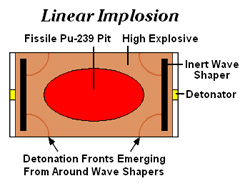 As disclosed in VizReport in 2005, Iran has likely been working with small-scale nuclear weapon designs since shortly after they received them from the A.Q. Khan proliferation network in the 1990s, along with some advanced centrifuge designs.
The warhead schematics, probably for Soviet-era scalable-yield nuclear landmine configurations, were designed to be small enough to be hidden inconspicuously on the battlefield, even inside hollowed-out rocks or logs. This also makes them ideal for deployment on small- to medium-scale ballistic or cruise missiles.
The same A.Q. Khan ‘care packages’ were received by Libya, North Korea and Iran, though Libya subsequently came clean and turned their materials over to the IAEA, effectively terminating their covert nuclear program. North Korea went on to produce a small arsenal of plutonium-driven atomic weapons, while Iran claims to be pursuing only a peaceful nuclear energy program. Today’s revelation, however, would seem to strongly suggest otherwise.
Furthermore, because the former Soviet designs were mostly plutonium-based, the IAEA investigation of Iran’s nuclear program may have perhaps focused erringly on its acknowledged uranium capabilities, rather than the possibility that it had initiated a dual-track weapons development approach.
~
For information on today’s disclosure, please read The Guardian’s story:
Exclusive coverage from The Guardian:
Iran tested advanced nuclear
warhead design – secret report
Watchdog fears Tehran has key component to put bombs in missiles
The UN’s nuclear watchdog has asked Iran to explain evidence suggesting that Iranian scientists have experimented with an advanced nuclear warhead design, the Guardian has learned.
The very existence of the technology, known as a “two-point implosion” device, is officially secret in both the US and Britain, but according to previously unpublished documentation in a dossier compiled by the International Atomic Energy Agency (IAEA), Iranian scientists may have tested high-explosive components of the design. The development was today described by nuclear experts as “breathtaking” and has added urgency to the effort to find a diplomatic solution to the Iranian nuclear crisis.
The sophisticated technology, once mastered, allows for the production of smaller and simpler warheads than older models. It reduces the diameter of a warhead and makes it easier to put a nuclear warhead on a missile.
Documentation referring to experiments testing a two-point detonation design are part of the evidence of nuclear weaponisation gathered by the IAEA and presented to Iran for its response.
The dossier, titled “Possible Military Dimensions of Iran’s Nuclear Program”, is drawn in part from reports submitted to it by western intelligence agencies.
The agency has in the past treated such reports with scepticism, particularly after the Iraq war. But its director general, Mohamed ElBaradei, has said the evidence of Iranian weaponisation “appears to have been derived from multiple sources over different periods of time, appears to be generally consistent, and is sufficiently comprehensive and detailed that it needs to be addressed by Iran”…
For more background on Pakistani scientist A.Q. Khan’s proliferation
network, see this September 10th story from the Economist.
LHC: The Beam is Back

CERN’s Large Hadron Collider is frosty and beaming, once again, after more than a year of repairs and testing that followed the eruptive escape of liquid helium into the tunnel that houses the massive supercollider. The device has now been chilled to 1.9°K (-271°C), making it colder than deep space (2.7°K); and low-energy ions have already been beamed part way around the 27 km ring in anticipation of some high-energy collisions in about a month.
UPDATE: November 18, 2009 — After being taken off-line last month by a mere breadcrumb dropped by a passing bird, the world’s most expensive machine prepares to power up again. BBC news link.
Proving Uncertainty
Dimensional solution for Heisenberg’s uncertainty principle:
The absolute position of a particle can be determined solely using 3d (xyz) space, but the motion of a particle must be evaluated in 4d (xyz+t) space. Both attributes cannot be known at the “same time” because that dimension (time) doesn’t exist in 3d space. The only exception would be a particle at perfect rest in its 4d environment, in which case, motion is nil and time is obviated as a meaningful factor. Meanwhile, the momentum of a particle may only be known in a type of “5d” (xyz+t+m) space.

 imahd.ca