Tag Archives: physics

What is Gravity made of ?

I saw an interesting question on the Big Question blog tonight:

Q: What is gravity made out of?

A: Gravity is made of mass. No mass. No gravity.

Mass has a natural affinity for mass. The attraction works in much
the same way that tiny bubbles in a liquid (the medium) tend to merge
into larger bubbles — with the difference being that the medium of
gravity is the vacuum that exists in both the atomic centre and in all
intervening distances between elemental masses, which, to an atom,
are indistinguishable from the vacuum of space. The concentric layers
of the atomic structure maintain a state of separation between the
internal and external vacuums creating an interactive ‘anti-medium’
which facilitates and exposes the observed ‘attractive’ mass effect.

In a somewhat wry, McLuhan-esque way: The medium is the massage.
.
For more on gravity
.

9 Comments

Filed under Reason, Science

Why the LHC won’t help us find the “god particle”

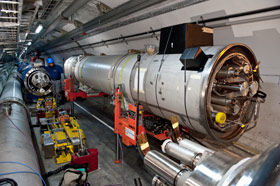
pr_06The Large Hadron Collider (LHC) at CERN near Geneva, Switzerland, was designed to create the same sort of high energy conditions that were present during the so-called “Big Bang”. Among the mysteries that Team LHC hopes to unravel: Revealing the nature of the theoretical substances known as “Dark Energy” and  “Dark Matter”; confirming the existence of the Higgs Boson (or “god particle”) as predicted by the Standard Model of quantum mechanics; and determining which, if any, of the current Grand Unification Theories is correct.

With respect to the Higgs Boson (the quantum particle thought to be responsible for giving atoms their mass) as well as with much respect to Dr. Higgs, I have a problem with the concept of a quantum “god particle”. My objection has little to do with the sacrilege of the name (offered by Leon Lederman in his 1993 popular science book), but rather the notion that one particular subatomic component can be responsible for all the mass of the unity to which it belongs.

There are two absolute states of unity in the universe: the atom (chiefly represented by hydrogen) which will endure indefinitely if sequestered from the transformative traumas of fission and fusion; and the universe itself (which has reportedly been around for a very, very long time). In between these absolutes exist myriad aggregations of matter displaying varying degrees of unity, mass, homogeneity and permanence: from planets, comets, stars and galaxies, to the seeming singularity of “black holes” — but each of these is simply echoic of our atomic and universal archetypes.

From everything I’ve read (never having had the pleasure of meeting the man) Peter Higgs seems to be a learned, conscientious physicist and a bona fide gentleman. This does not, however, vaccinate him against ever having a bad idea.

So, it has to be said:   The mass of the atom comes from the functional structure of the atom itself, not from a theoretical subatomic particle. Simply put, the atom is the “god particle” — and so is the Universe.


Keep up to date on LHC activities at CERN.

.

10 Comments

Filed under Reason, Science

On Gravity


Gravity is a non-waveform phenomenon.


Light responds to gravity at the speed of light.


Gravity is atemporal but its effects cascade through time.


— from Steinman’s “Attributes of G”

1 Comment

Filed under 10 Words or Less, Science

Why I’m Not Concerned About the Ultimate Fate of Israel

ahmadinejad-un2No matter how obnoxious the rhetoric coming from Iran’s president, it’s difficult for me to imagine that Israel would not be able to respectably defend itself (and more) in any major conflict with the Persian state.

The reputation of Jewish scientists, as a whole, is well established. Despite comprising only 0.25% of the world’s population, Jews have nevertheless managed to rack up a considerable collection of Nobel—and other—prizes in Science.

Nobel Prize for Chemistry — 20% of total

Nobel Prize for Physics — 26% of total

Nobel Prize for Physiology/Medicine — 28% of total

Kyoto Prize — 26% of total

Wolf Foundation Prize — 34% of total

US National Medal of Science — 38% of total

* jinfo.org (2009)

Allied efforts during the First World War were greatly enhanced by the work of a Jewish chemist named Chaim Weizmann who invented a way to more easily manufacture acetone, a key ingredient in cordite-based explosives. Weizmann later went on to become the first President of Israel.

During the Second World War, the work of Jewish physicists like Albert Einstein, Robert Oppenheimer, Leo Szilárd, Niels Bohr, Albert Michelson, Wolfgang Pauli, Felix Bloch, Edward Teller, Lev Landau, and many others, made possible the harnessing (and unleashing) of nuclear energy.

I certainly hope that a third war will not make it necessary for such talented individuals to demonstrate what they might be able to come up with next.

Psalm 92 speaks of those times when David/Israel were/are/will be under fire from many sides, beset by numerous enemies. And it seems that every time this occurs, new revelations about the nature of matter and energy do indeed arise. Or, as it says in the psalm:

Psalm 18:16  (18:15 in some versions)
Then were seen the channels of the waters,
and the foundations of the world were laid bare
at thy rebuke, O LORD, at the blast of the breath of thy nostrils.

The word ‘waters’ can be synonymous with power or energy, which,
along with the foundations of the world (matter), will be revealed
when the encompassing enemies of Israel are rebuked by G-d.

3 Comments

Filed under Conflict, Reason, Science

DPRK: N-Test, Take X

The UN Security Council has unanimously condemned North Korea’s latest nuclear firing test, which everyone seems to be assuming is their second such detonation, though that might not be the case.

The precise yield of the explosion is difficult to gauge for the following reasons: 

  1. Given the DPRK’s proficiency at digging shafts, tunnels and underground facilities, they may be successfully shielding and shaping their blasts in order to minimise their seismic signatures. If different device placement configurations are used for each test, this will help to confound those attempting to ‘profile’ the device in question — and, over a series, it will tell the North Koreans which configurations work best.
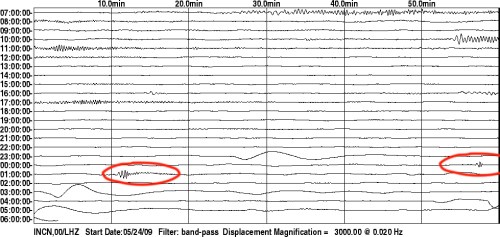
  2. The seismic waves generated by the most recent test are distinctly different from their first known test on October 9, 2006, which could mean that a different device type may have been employed this time, in which case, the previous data will be somewhat less useful in determining the energy output of the test at hand.
  3. Russian seismographs have been off-line for quite some time, limiting the number of high quality data points when interpreting the test’s meaning and ultimate implications. The Chinese ones have been running off-and-on for a good part of the past few months, which has proved less than helpful to seismic monitoring efforts focused on that part of the world. 

INCN_24hr
As compared to the first test, the blast barely registered a blip at China’s QIZ seismograph located at Guangzhou, Guangdong Province, which responded quite emphatically to the October 9th test. (See last story this topic.)

QIZ_24hr
Russian sources estimate the test’s yield to be in the range of 10 to 20 kilotons — which are the same figures they proposed for the first test, which turned out only to have generated a blast force of less than one kiloton. It makes you wonder about the value of Russian contributions on these matters. 

I’m still digesting the news (and the data), but I’ll take a stab at guessing the yield on this newest test — which could be anything from the country’s second to tenth nuclear test.

Best guesstimate at this time: 5 – 10 kT.
 
Note: There is also a possibility that two tests could have been conducted in almost immediate sequence (about 15 minutes apart) — with the second test of the day yielding roughly double the energy of the first. In other words: two tests registering 5 kT and 10 kT, respectively. (I can’t find a quake to match up with that second, slightly larger, blip. Maybe you can.)

INCN_24hr_2 

Did North Korea score a 2-for-1 deal once again?

Now, I guess we just wait to see what happens next.

5 Comments

Filed under Chicanery, Conflict, Images, Science